

At the peak of his success in Cubist painting, Pablo Picasso (1881-1973) uttered these words: “We must kill modern art. It means, too, that we must kill ourselves if we want to go on accomplishing anything.” It’s a philosophy that perhaps summarises the entire body of work from him and his compatriot, Joan Mirò (1893-1983). Each man constantly reinvented his range of styles over the decades.
This month, Sergio Gaddi has curated 267 pieces of artwork, together with art events company Alpha Soul, from private collections and art institutions around the world. The exhibition explores the intertwining lives and work of both artists through a series of original lithographs, ceramics and graphics. “It’s important to note that the graphical experience is not at all secondary to oil painting, but often expresses the real and true soul of the artists,” says Gaddi. “They used many techniques — drawing, painting, ceramics, sculpture, graphics — and dominated them all.”
Gaddi hopes that the exhibition will help people to “rediscover the visible and invisible things of their imagination”. Here, he talks Esquire Middle East through some of the key pieces:
***
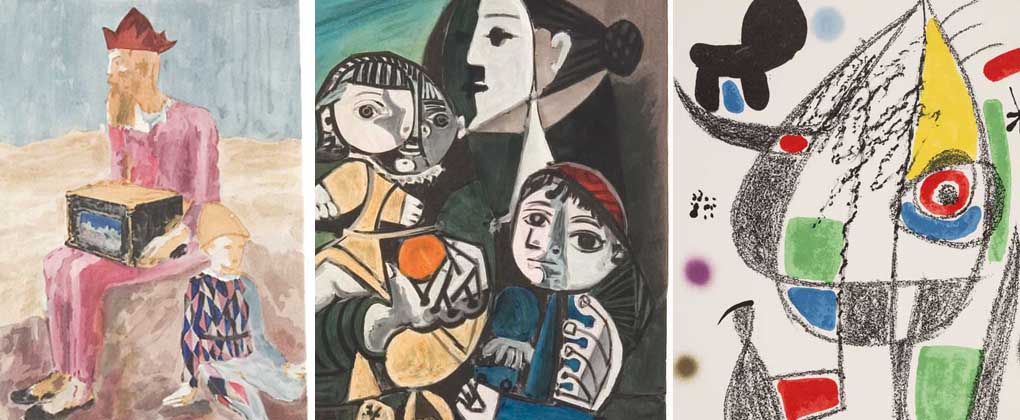
Acrobat sitting with a boy – Picasso, 1906
The original painting, from which this print is derived, is one of the high points of early twentieth century painting. The painter expresses the sadness and loneliness of the characters, not only through the enunciation of the beautiful colours, but also stretching his figures almost to deformed shapes. Picasso paid particular attention to the marginalised characters in society. They were a constant source of study and experimentation, drawn from every corner of the streets of Barcelona. An anonymous place hosts the two figures, and an irreparable solitude surrounds them both.
Mere Children has L`orange – Picasso, 1951

From a white background emerge the colourful characters of a woman with her children, identifiable as Picasso’s partner, Francoise Gilot, and their two children, Claude and Paloma. The broken lines are softened by blue, green and orange spots. It’s a moment of tender motherly love, of family intimacy. Picasso’s work wasn’t concerned with development or historical sequence, but rather a continuous transformation, a constant spontaneous rejuvenation that addresses not only the artistic life, but also his daily life’s work. This is one of the last autobiographical glimpses of the love story with Gilot; mainly because of the attention that Picasso began to pay another woman, the young Geneviève Laporte.
Maravillas con Variaciones – Miro, 1975

Although this may seem incredible for an artist in full command of his technique, Miró continued to experiment into the 1970s, looking for new experiences without ever falling into routine. He once said of this period, “I always work in a state of passion and fury, like obeying a physical impulse, to a drain. It’s like a fight between me and the canvas, between me and my malaise; working until this malaise passes”. During this time he wanted his art to reach broad sectors of society, what he called ‘anonymity’, within the reach of the people instead of the gallery or museum.
– – –
March 7-May 17, Burj Khalifa, Annex L1. Dhs125 from Platinumlist.net and Ticketmaster.ae. Part of the proceeds will be donated to the Al Noor Training Centre for children with special needs.