
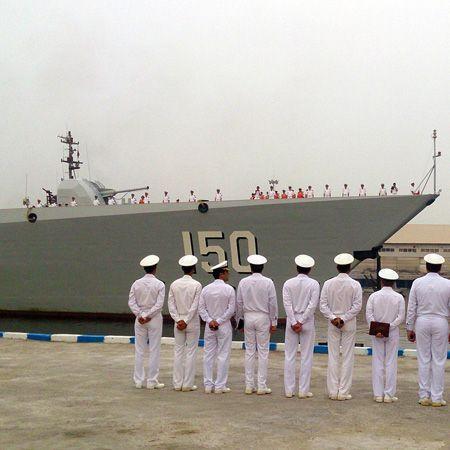

As the frigate Changchun and destroyer Changzhou nosed into the Iranian port of Bandar Abbas last September, local residents marvelled at their sleek superstructures and rows of immaculately attired sailors. China might be well known in Iran for its ancient civilisation and cheap household products, but not for ostentatious displays of hard power. Many wondered how the Americans, who have long been self-appointed guardians of the Gulf, were going to react.
With the mighty Fifth Fleet of the United States based across the Strait of Hormuz in Bahrain, the combined firepower of the two Chinese ships would hardly have had the Americans quaking in their dress blues. But the Chinese Navy’s first ever port of call in the Gulf was more than just a tit-for-tat display of military might. As a statement of intent it hinted at how the regional balance of power may be imperceptibly shifting.
A developing country with a recent history of humiliation at the hands of foreign aggressors, nobody appreciates the importance of hard power in protecting interests more than China. Beijing may have adopted a placatory approach to foreign policy since opening up, but then again there is an old Chinese idiom, Guojia zunyan shi da chulai de, which translates as “National respect can only be obtained through fighting”. This aptly demonstrates how the Middle Kingdom’s velvet glove frequently conceals an iron fist.
And when it comes to oil supplies and Gulf security, China’s velvet gloves are slowly slipping off.

Dazhe Xu, chairman of the China Atomic Energy Authority talks at the IAEA General Conference on September 22, 2014 in Vienna, where the Iran nuclear programme was discussed.
China’s thirst for oil
According to current estimates, over one quarter of the world’s remaining oil reserves are located in and around the Arabian Gulf. The Chinese could easily consume them all. Few people realise that China itself is the world’s fifth-largest oil producer. In 2013 it pumped around four million barrels per day (bpd) — slightly less than Iran. Yet this is far from enough to satisfy the country’s increasingly voracious energy appetite. In 1980, China consumed a mere three percent of the world’s oil. This has now risen to over 10 percent. In September 2013, China’s net imports of oil exceeded those of the United States on a monthly basis for the first time, making it the largest net importer in the world.
Iran has been happy to feed China’s addiction. Since sanctions on the republic were relaxed in late 2013, Tehran has ramped up its efforts to shift its oil eastwards. Chinese customs data show that Iranian oil imports in the first six months of 2014 increased nearly 50 percent year-on-year to 630,000 barrels per day. The fact that Iranian crude is now fuelling the Chinese economy like never before is giving Beijing’s power brokers sleepless nights. China’s economic boom has lifted living standards and increased its global influence. But communist leaders view their country’s demand for imported hydrocarbons as a strategic weakness, especially when those hydrocarbons come from such a volatile region as the Gulf. This goes a long way to explaining the inaugural presence of the Chinese navy in Bandar Abbas.
Safeguarding supply routes
Separating Iran from Oman, the Strait of Hormuz at its narrowest point is only 39 kilometres wide – the very definition of a strategic bottleneck. It is through here that 20 percent of China’s oil imports must be transported, which explains why Beijing also frets about the constant presence of heavy US naval units nearby. Many Western analysts dismiss the idea of an upcoming naval struggle to control sea lanes between the Middle East and Asia. But there is little doubt that securing trade routes, as well as countering US influence, features prominently in Beijing’s current thinking.
For the time being, at least, naval cooperation between China and Iran is therefore mutually beneficial. Iran already plays an important role in protecting Chinese shipping against pirates. Over the past two years its navy has rescued two Chinese vessels from hijacking. In doing so, it can conveniently demonstrate to the world that it doesn’t regard the Arabian Gulf and its environs as a private fiefdom of the United States.
As well as safeguarding her national assets, China’s ongoing anti-piracy operations in the Indian Ocean continue to hone the abilities of Chinese naval personnel and platforms. The Chinese navy has, over the last six years, contributed to the safety of the Gulf of Aden and its neighbouring economic lifelines, through escorts, area patrols and on-ship protection. For an aspiring naval power, this is no mean achievement.
Enhanced logistical supply chains, improved intra-navy coordination and greater focus on sailors’ morale are all developments that will undoubtedly benefit future Chinese naval outreach in the Gulf. As the Chinese publication The Global Times recently stated, the fact that Chinese naval personnel are now moving from “maritime rookies” to “confident seadogs” means that China has already “sharpened its Far Seas sword”.
“Iran and China have had close military cooperation since the Iran-Iraq war,” says Seyed Ali Alavi, an analyst at the University of London’s School of Oriental and African Studies. “The recent joint naval drills in the Arabian Gulf represent a deepening of this relationship. Beijing wants to send a message that there are global powers in the Gulf other than the US and its allies.”

Iranian President Hassan Rouhani and China’s President Xi Jinping in Shanghai on May 22, 2014.
The benefit of sanctions
Despite nearly a year of negotiations over Iran’s nuclear programme, it was unclear going to press whether Tehran and the P5+1 powers (the US, UK, France, Germany, Russia and China) would broker a deal by the end of their discussions in Vienna on November 24. One possible scenario is an extension of the interim agreement first agreed in November 2013 that offered limited sanctions relief.
While China has publicly encouraged Iran to drop its nuclear weapons programme, this continuation of the standoff suits Beijing just fine. “Thanks to sanctions, the Chinese have enjoyed virtually unfettered access to Iran,” says Cliff Kupchan, chairman of political risk consultancy Eurasia Group. “With a complete absence of the so-called Big Oil giants they have benefited from a lot of easy plays within the hydrocarbon sector.” China has also lent its tacit support to sanctions against Iran, but has done so on the condition that they exclude the country’s energy sector. Oil companies from most other countries have pulled out or shied away from investment in Iran as a result of international pressure and an unfavourable business environment. Chinese firms have chosen instead to strictly adhere to the terms of United Nations Resolution 1929, which contain no explicit restrictions on energy investment or trade.
“The fact that both China and Iran are relatively authoritarian, non-democratic and reject Western intervention in their domestic affairs gives them much in common”,” says Bijan Khajehpour, managing partner of the Vienna-based consultancy Atieh International. “Beijing would certainly be concerned if Iran became more democratic, or began to realign itself with the West.”

US Secretary of State John Kerry and Iranian Foreign Minister Javad Zarif meet in Muscat on November 9, 2014 to try and reach a breakthrough in the nuclear talks.
Iran looks west
Over the years, economic isolation and mismanagement have taken a serious toll on the Iranian oil industry, which now badly lacks the expertise and infrastructure to extract its own crude. Many Iranian firms have experienced problems with the quality of Chinese products and are frustrated at the lack of Chinese technical expertise. The prospect of Big Oil returning to Iran, should some sort of nuclear deal be reached, could therefore be bad news for Beijing.
“Despite all the rhetoric, Iran values its ties with the West, both economic and otherwise,” says Khajehpour. “It would certainly benefit from Western expertise and technology in the energy sector. If sanctions are lifted, many Iranian oil companies will undoubtedly shift their focus westward.”
“Essentially, Iran doesn’t trust the Chinese and would rather see its ties to the West improve, which is partly why they have been conducting these nuclear negotiations,” adds Dina Esfandiary, a research associate involved with the Non-Proliferation and Disarmament Programme at the International Institute for Strategic Studies in London.
So why have Iran and China been more vocal about their relations, made conspicuous by the naval drills in Bandar Abbas? “Iran wants to demonstrate that it has a Plan B lined up if nuclear negotiations collapse,” concludes Esfandiary.
“It is no coincidence that this exercise took place two months before a deadline for reaching a deal on Iran’s nuclear programme,” says Dr. Michal Meidan. “The drills not only reflect the strategic importance that China attaches to Iran, but also Beijing’s concern over a potential easing of sanctions.”

A picture provided by the Iranian news agency IRNA shows a Chinese navy destroyer at the Iranian port of Bandar Abbas on September 20, 2014.
China’s main priority: China
While naval cooperation between China and Iran may indicate a united approach against perceived US hegemony in the Gulf region, analysts say it would be a mistake to conclude that China frames its entire policy around what America is or isn’t doing. China, being China, will always operate first and foremost along opportunistic lines.
And what really matters to China is protecting its energy supplies. For this reason, Beijing continues to focus on its pipeline network into Central Asia as a means of lowering reliance on oil that has to be tankered in via potentially risky sea lanes. But in the meantime it requires stability in the Gulf to protect those supply lines. “Chinese policy towards Iran has always been China-centric, rather than America-centric,” says Yun Sun, a fellow with the East Asia Program at the Washington DC-based Stimson Centre. “China seeks economic gains, regardless of whether they are at America’s expense or not.”
This thinking discredits the views of some scholars who have recently gone so far as to suggest that a grand coalition between Iran, China and possibly Russia poses an immediate threat to US influence in the Middle East. “I don’t buy into this coalition argument,” says Cliff Kupchan. “China has been a free rider on US power for years. Chinese export growth has taken place in a global trade environment facilitated by America. China may object to what it sees as American unilateralism, but it knows the US still holds the key to global security and economic growth.”
An America-free Middle East?
Historically, oil and energy security have been at the heart of American strategy in the Gulf. Since the 2003 invasion of Iraq, however, the limits of American power and constraining effects of the United States’ Gulf partnerships have been painfully evident. There is a growing chorus of calls in Washington for America to cut its losses and scale back on its Middle East commitments.
This prospect has been made more possible by the US domestic oil and gas boom, thanks to new shale extraction technology. American dependence on Gulf oil is on the wane and, over time, many experts predict this may see Washington significantly reduce its military presence in the region.
But could China fill that gap? And would it want to? Its navy, which only owns one aircraft carrier, still has limited experience of being a maritime enforcer. Beijing is more concerned with patrolling the South China Sea, which many in China consider the “second Arabian Gulf”, thanks to this body of water’s own rich oil supplies. How far it would go to fill a possible power vacuum in the Gulf is hotly debated.
“China may increase its diplomatic outreach to Middle Eastern countries, and gradually develop a naval presence in the region, but in my opinion this will be modest and exploratory to begin with,” says Dr. Michal Meidan, director at China Matters, a consultancy providing analysis of the politics and geopolitics of China’s energy sector. “We are talking five to 10 years here.”
“These recent naval drills are simple posturing,” agrees Kupchan. “China might have ramped up its military capability in recent years, but it has been reluctant to increase its military presence, especially outside the South China Sea.”
What would draw them more significantly into the region? “The Chinese are naturally cautious,” says Kupchan. “However, if the US really withdraws from the region, they may have little choice but to step in.”

Chinese tourists visit the “Gate of All Nations” at the ancient Persian city of Persepolis near Shiraz in southern Iran on September 26, 2014.
The cautious partners move forward
Over the coming years Tehran will undoubtedly continue to strengthen its economic relationship with China, as it sees the country as a powerful trade partner that can help it develop. But this will be a nuanced relationship that depends on many other factors, rather than a marriage born of romantic ideals. Many key Iranian decision-makers are still driven by the revolutionary goal of full independence — the “neither East nor West” philosophy. China, meanwhile, probably doesn’t harbour grand near-term ambitions to challenge American supremacy. But Tehran knows that Beijing’s reliance on Middle Eastern oil may eventually force it to establish a significant military presence in or near the Gulf, with or without Iranian assistance, should the American position change or the geopolitics of the region realign unfavourably for China.
There are plenty of signs of precautions being taken by Beijing. It has already issued a stern warning to Tehran not to close the Strait of Hormuz, while the construction of a Chinese naval base somewhere in the Gulf of Aden was recently mooted by a Chinese admiral. The newly opened Chinese-built deep-water port of Gwadar in southern Pakistan, right next to the Iranian border, is another possible base location.
“Iran does not wish to be seen as overly dependent on China,” says Bijan Khajehpour. “I think we will see cooperation and competition between the two countries at the same time. The key determinant for both Chinese and Iranian policies and actions will be the Western approach to Iran and the Gulf region in general.”
The three way competition
As it negotiates the middle ground between the U.S. and China, Iran is walking a fine line. With powerful American naval units still stationed in its own backyard, Tehran rightly considers America its greatest security threat in the short-term. But if the nascent rapprochement between Iran and the West – driven by Tehran’s desire to boost its economy – blossoms into an entente cordiale this may not always be the case. On the other hand, cosying up to the West too much may have undesirable implications vis-à-vis China. As ever, Middle Eastern politics is a tangled web of relationships where national interests frequently collide.
Beijing’s pressing need for energy security, Washington’s desire to contain Chinese influence, and Iran’s quest for much-needed economic development are part of a three-way geopolitical poker game where the stakes are constantly shifting. The arrival of the Chinese navy in Bandar Abbas shows that Beijing is playing with an increasingly strong hand.