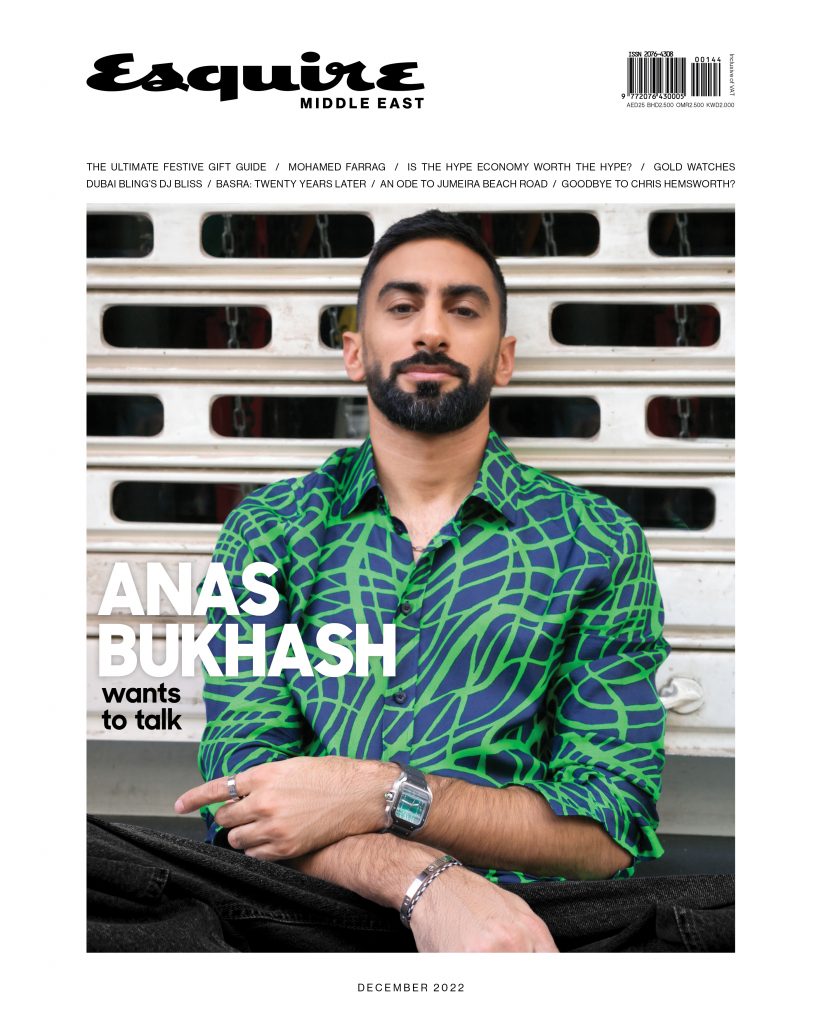

Emirati entrepreneur and interviewer Anas Bukhash is at the top of his game. So, what makes him tick?
I first met Anas Bukhash at a dinner in Dubai. As we sat across from each other, I knew I’d be interviewing him soon for this story, but he didn’t know who I was. I wanted to start chatting with him before anyone made the proper introductions and the inevitable forced familiarity – common friends, interests – found its way into the conversation.
Once the small talk was out of the way – in record time —we got to the real stuff. In his trademark calm, measured tone Bukhash gave me advice on how to stay true to myself in a city that can seduce you, lead you astray. He told me about the areas he feels most connected to the city, the food that keeps him fed – and humble. It felt incredibly intimate and sincere in an really short time. The persona on screen was the person in front of me.
Chances are you don’t need me to tell you who Anas Bukhash is. His extremely popular #ABtalks show on YouTube and Netflix is watched by millions across the world. In many ways, Bukhash is the Arab world’s psychologist, sitting people down – mainly celebrities – in a minimally decorated room to ask them the questions still considered taboo in communities across the region. How are you really feeling? Do you get depressed? Things were are taught to just get through, to keep inside.
Besides being a successful interviewer, Bukhash is a successful entrepreneur. When we agreed to meet, the location was set as his warehouse office in the Alserkal Avenue arts district of Dubai’s Al Quoz. You come to realise that he doesn’t leave much to chance and that asking to be interviewed in the safe confines of his office must offer practicality – but also some degree of control.
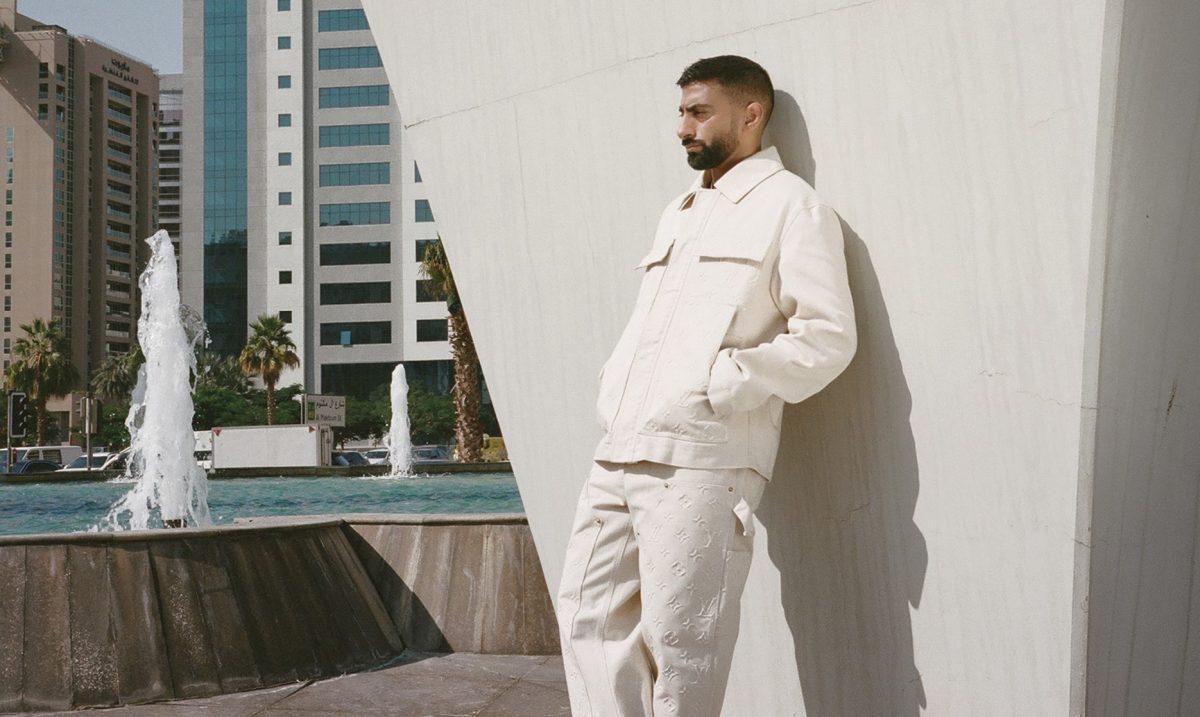
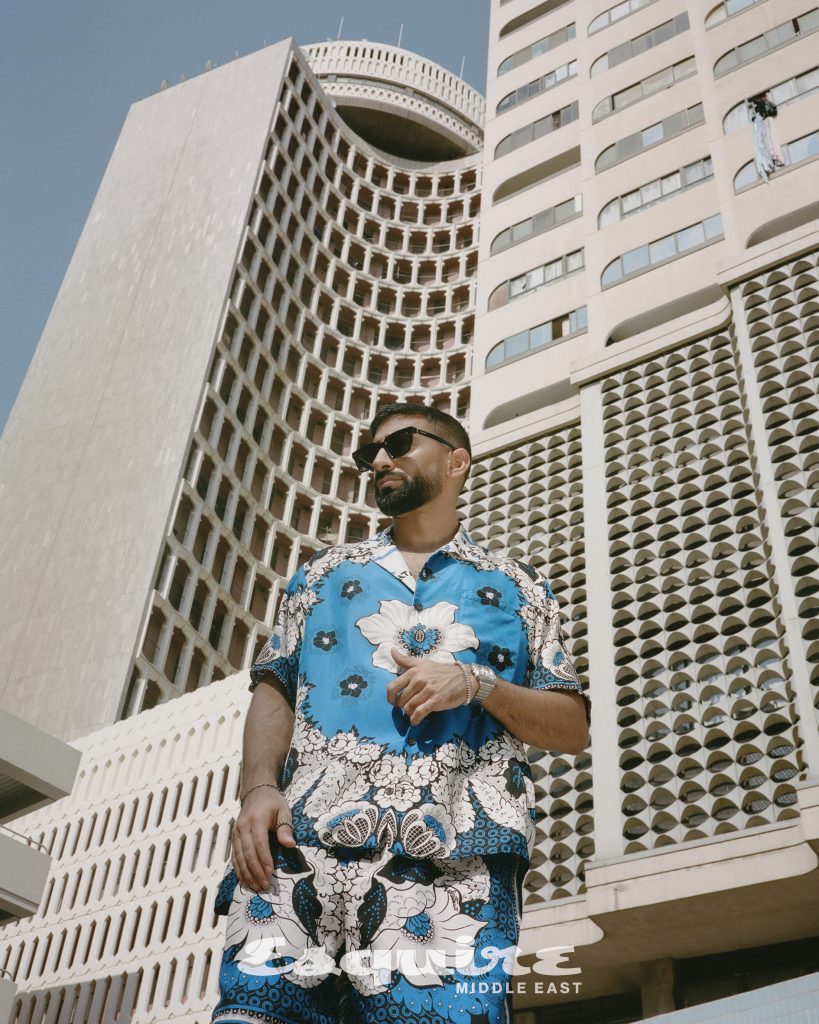
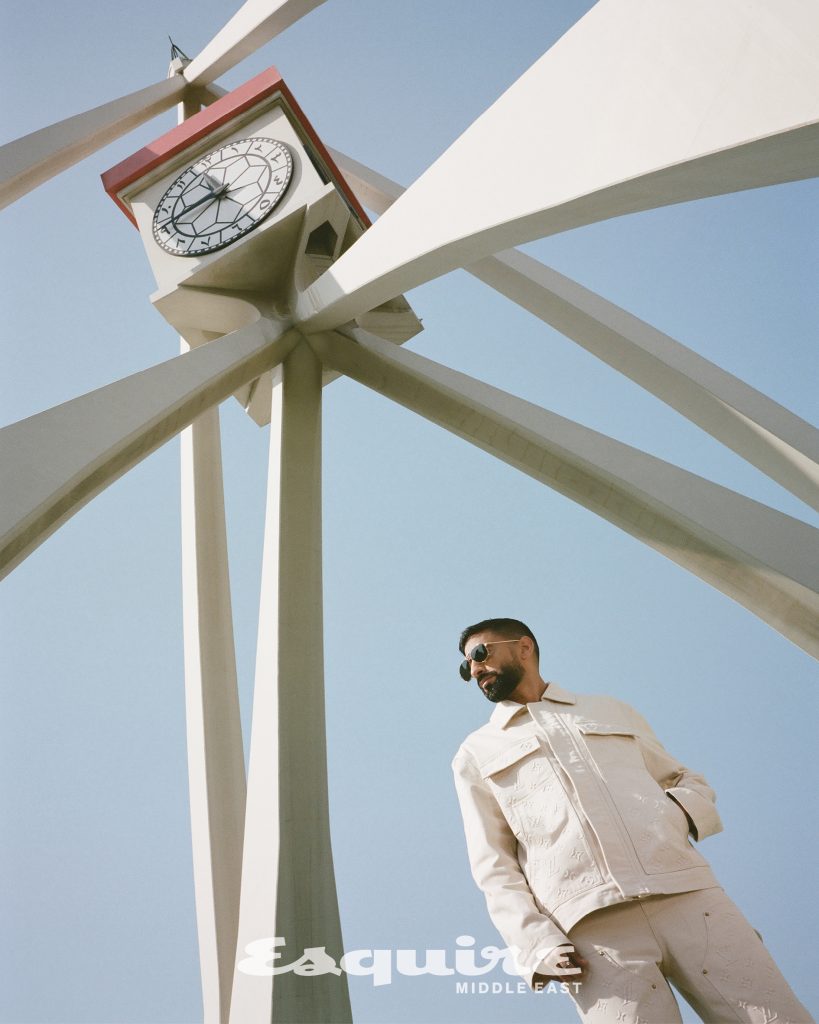
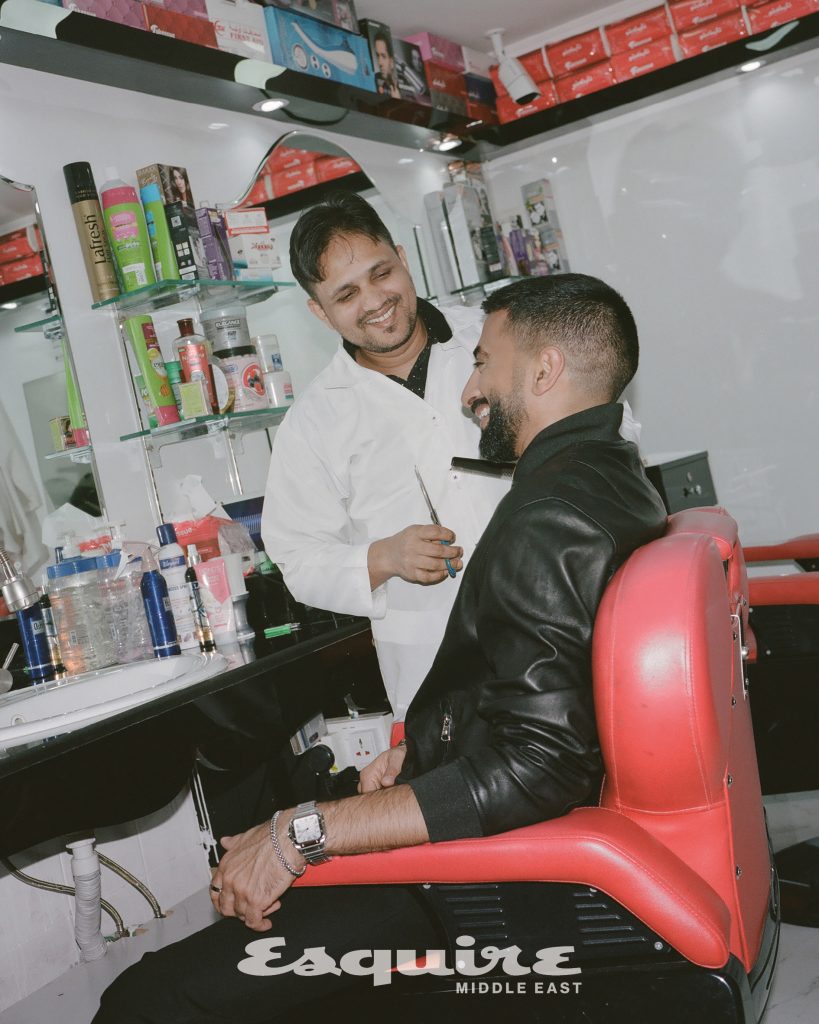
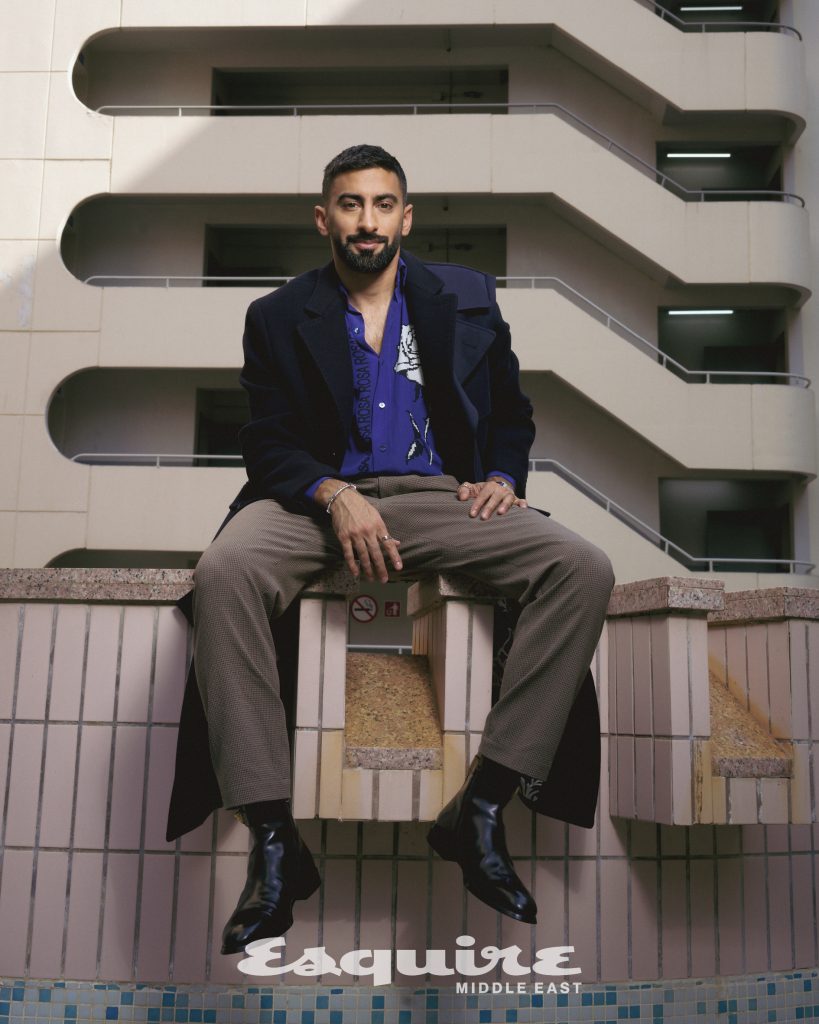
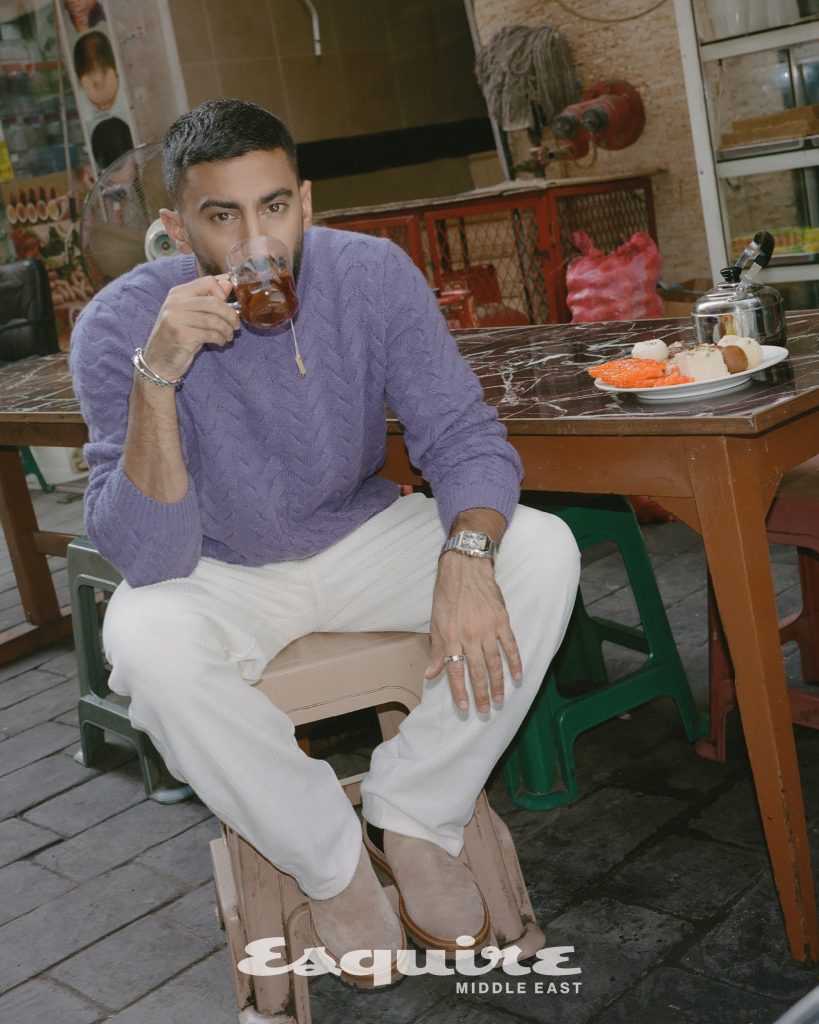
A day earlier Bukhash was on the streets of Deira, the historic heart of the city, with the Esquire Middle East team for the photoshoot you see in these pages. At the start of the day, it seemed like it was an uncomfortable experience for him. It was unstructured, free-flowing, and slightly chaotic – the opposite of everything Bukhash has baked into his professional life.
The deeper we get into our conversation, the more I realise I’m failing to break Bukhash. I have this sudden realisation that I have shifted from interviewer to interviewee. My questions are getting longer. They aren’t really questions at all at some point – I talk about my parents and the friends I should call. Bukhash has such a calm demeanour that you can’t help but furnish the space between you with admissions. He considers your every word and in turn considers his own.
As we sit here in his huge, open-plan office, a team huddled on a nearby table, their electric scooters charging by a wall of sockets – I realise he’s intentionally leaving silences in the air between us. He will not volunteer anything that I don’t extract from him. I remark on the pacing of his answers.
“It’s a good observation,” he says disarmingly. “That’s something you teach yourself because we’re taught not to be comfortable with blanks. And I always find it funny when you go into an elevator, as soon as the door closes, everybody takes out their phones, they’re so uncomfortable in a blank. Sometimes the blank is more important than the words.”
Since #ABtalks started, Bukhash has sat down with over 130 guests – subjects, really. His YouTube channel has a whopping 1.5 million subscribers and a total of over 130 million views. Around 50 of his interviews have over 1 million views. He hasn’t done this alone and is the first to credit his team for the success. You can tell a lot about a leader by the team they lead.
As we chat, people who work with Bukhash come to say hi, all smiles. I wish them a good weekend, but they’re having none of it. There’s work to be done. They’re genuinely excited to be here. His agent also sits nearby. Normally, I’d find it disruptive but every time she interjects, she enriches the conversation, makes me think of something I’ve overlooked. Greatness is found in the agency of others.

This must be by design. Bukhash has created a life out of efficiency and processes. The kind of things that can seem boring but that create discipline – and in this case, success. We discuss our mutual love of keeping a calendar and hatred of leaving emails unanswered and WhatsApp messages unread.
“I think I take after my father when it comes to organisation skills. He’s very organised. Even his address book on his phone has its own coding system. I’m organised because of genetics. The other part is I really don’t like the feeling of being ignored,” he says surprisingly.
“So, I don’t want to ignore. I’d rather hear ‘no’ than nothing. Nothing is vague. I really don’t do well with vagueness. I’d rather somebody say, ‘not interested’. But don’t keep me in limbo. So, I don’t like to keep people in limbo.”
Bukhash’s early career was a kind of limbo, moving from job to job in three-year cycles. But it also placed him at the centre of the fabric of contemporary Dubai and Emirati life more broadly– from working as an engineer on the oil fields to property development to philanthropy to being CCO of the UAE professional football league. He followed that by venturing into entrepreneurship – where he seems much happier – founding homegrown favourites Ahdaaf, Buka, Not (So) Guilty, Chalk Salon and of course Bukhash Brothers. A sports club, a streetwear brand, a street food concept, a salon and an influencer marketing agency – it’s a diverse portfolio but when you know the man, it makes sense. What does being his own boss really mean to him?
“What I learned when I became my own boss is that I do things the way I believe they should be in terms of ethics, ethos, values. I wake up and I express myself: how I dress, how I manage my schedule. I’m a free person. I’m very lucky. I own my time. [The corporate world] never suited me because you punch in at this time and you punch out at this time. And if you’re two minutes late you’re in trouble but everybody there is reading a newspaper for an hour and having croissants and they’re gossiping. So, it never made sense to me, how it’s structured,” he says.

But freedom from corporate tyranny doesn’t mean Bukhash is a laid-back surfer type. His life is planned out to the minute. I’ve never set up a more efficient interview. It was all calendar entries and beautiful email threads. As an organisation nerd myself, it put me at ease. I wonder if there’s such a thing as being too process-driven though. If it interferes with the moments between the planning.
“I think before I was way more logic-based and way more objective-based,” says Bukhash. “I still am to a high degree, but I think also the show really humanised me,” he admits.
“I don’t think you cannot be humanised through #ABtalks. You realise you’re not the centre of the world. You realise there are many stories and that you can learn so much from those people if you listen. I think being a dad softened me up too. But still, if somebody comes and complains I’ll be “Ok how can we solve this?” and sometimes they just want you to listen, not to give advice. And I think that’s something I had to learn. And that I am still learning.”
As we discuss the role of organisation in his success – his manager interjects and adds the word ‘consistency’. Bukhash has never missed an episode of his show. Even during the pandemic, the show continued seamlessly because he’d banked episodes for a rainy day.
“The biggest failure in any entrepreneur’s life is a lack of consistency,” he says. “Consistency is the only assurance of success. It’s not control, it’s more consistency.”
He brings up a guest who was recently on his show and had done a management course at Harvard. He was asked a question on that course that he wanted to pass on. What would you change if you knew you were going to die in three years? “It’s not like in a year because suddenly you’re in a rush,” says Bukhash.
“No, you have three years. It’s such an interesting question with an interesting period of time. And he asked me, ‘What would you change?’ I thought about it, I took my time and I concluded, not much. He said I was maybe the first person to say that. He said I was really blessed.”

Surely, he can’t have it all figured out, I think to myself. There must be something wrong with this life set-up.
“It’s beautiful to be routine based, which I am. But do you miss out on nice random moments? You do. So, I made a promise to myself that when I get extremely nervous, anxious–or whatever you want to call it –when I want to leave work and my routine for a while, let’s say 10 days of travel, I’ll allow myself a weekend away instead. That’s as much as I can manage.”
It feels like Bukhash is in constant negotiation with himself. It feels like it might be exhausting, although it doesn’t seem to be for him. It seems, for want of a better word, optimal.
Amidst all this success, what has Anas Bukhash failed at? “Failed businesses for sure, that could have done better or needed more attention,” he says. After a characteristic pause, he continues: “Some people will see divorce as a failure. I don’t because we’re in a great space. We have beautiful kids. You know, I have two gifts – my children – and a woman who gave me nine years of her life. How can you be ungrateful?” He says that after seeing so many bad divorces around him he wanted to make his “beautiful”. “I know it’s a weird statement,” he admits, “but we’re good parents. I think we’re a good example to the Arab world that divorce doesn’t have to be ugly.”

The conversations Bukhash has on his show go beyond one-off insights into a succession of intriguing characters. They’re documentation of a moment in time in Arab culture. Because these guests don’t open up this way anywhere else, these videos are the only source of – as Anas might put it – how the Arab world is really feeling. It isn’t random. Bukhash spent time in traditional television and saw what was slipping through the cracks.
“Ads, seven-minute interviews, read from the teleprompter. Only dress this way. Don’t say these words. I understand that’s what suits TV, but it didn’t suit me,” he recalls. “I was sitting opposite Samir Ghanem, God rest his soul. And I’m looking at him and I’m thinking ‘No! How is he here for only 7 minutes?’ It’s ridiculous, he’s a wealth of information and history. And he wasn’t well, so it was a privilege to have him there. I was thinking ‘how much knowledge is sitting next to me, and I can’t even listen to it.’” It’s clear the experience has marked him, and he’s taken the opposite ethos for his own show.
It’s often been said that Bukhash is vulnerable in his interviews, and that that allows his guests to be vulnerable too. But I don’t think he is. He may be incisive, thoughtful, empathetic. But not vulnerable. “You know what? Because it’s not about me,” he says. “It doesn’t matter what I feel. If I’m self-obsessed, I’ll start crying and telling them how I feel and then I’m really removing the attention from what I’m sitting there for.”
As Bukhash tells me about a heart-wrenching moment in one of his #ABtalks Untold Stories series, which finds human interest stories away from the world of celebrities, I push him again. There must be a nightmare scenario he has been afraid of. Moments where he was not in control, however hard he tried.
“They were the moments when I was helpless,” he admits. “Because that’s the contradiction of control. I’m an elder brother. I’m wired to solve problems. The worst moments were the moments where nothing was in my hands. Where I just had to wait.”
If you fancy sitting down across from Bukhash for an interview, you might be in luck. He tells me there’s an #ABtalks game that’s been developed. It started when he and his team noticed people interviewing each other on social media using his questions. There was a kind of hunger out in the real world to have these kinds of conversations, so the game will provide that – a format to sit and have meaningful conversation with those around you. Everything was done in house, from game design to mechanics – as you’d imagine.
“You’d be shocked how many people have been on the show and then they say, ‘you know, I never sat down and thought about what I just said’. Imagine we can do that in people’s houses.”
Credits
Editorial Director: Matthew Baxter-Priest
Editor in Chief: Nasri Atallah
Digital Editor: William Mullally
Talent: Anas Bukhash
Photographer: Prod Antzoulis
Styling: Laura Brown
Senior Producer: Steff Hawker
Fashion Assistant: Poucy ElShahawy
Grooming: Gael Sastre
Photo Assistant: Mary Lileonova
Photo Assistant: Jaypee Hardin
Watch and jewelry by Cartier
Read our full Anas Bukhash cover story in the December issue of Esquire Middle East, on newsstands now