
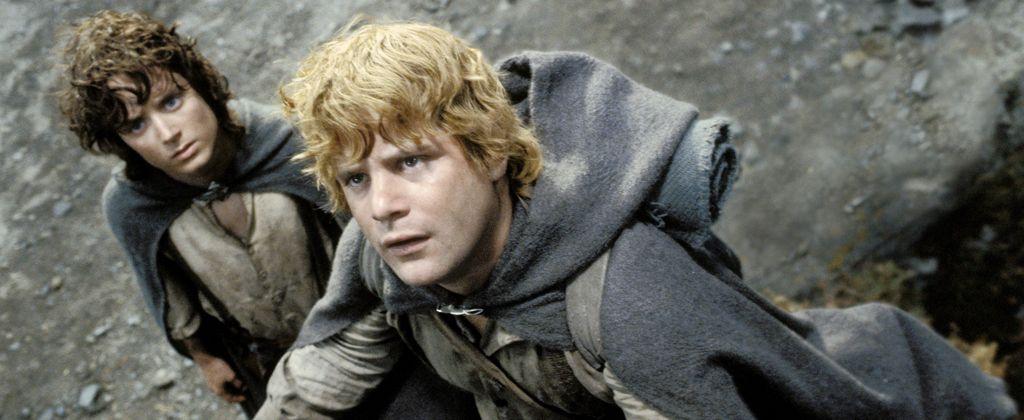

Samwise Gamgee – Lord of the Rings (above)
We know Frodo Baggins gets all the credit for saving Middle Earth in J R.R Tolkein’s epic tome, but let’s face it, without his overzealous gardener Sam by his side, the furry footed diva wouldn’t have made it past the front-gate of his hobbit hole.
Moody and whining throughout, if Frodo’s not berating Sam for “eating too much Elven bread”, he’s openly criticising him for not trusting his schizophrenic new pal Gollum – who later tries to kill him on a multiple occasions. But does Sam give it the “I told you so?” Does he heck.
Instead, he rescues the young Baggins countless times, and – at the book’s conclusion when Frodo has decided he can’t be arsed with an uphill trek anymore – quite literally carries him into the fires of Mount Doom, saving the day. Here’s to you Sammy.
Waylon Smithers – The Simpsons

While his intentions towards his boss Mr Burns, may not be strictly – shall we say – honourable, Waylon Smithers has time and time again proved himself to be the most loyal of corporate number twos.
Working under the official title of ‘executive assistant’, (a role that, by his own admission, is “actually about 2,800 smaller jobs) Smithers’ brand of discipline has won him countless employee of the month awards, but still the desperately sought position of vice president eludes him. Not that this diminishes his unerring devotion to his employer, even when Mr Burns bestows said vice presidency on a dog in one episode. At a nuclear power plant with Mr Burns at the helm and Homer Simpson working as chief safety inspector, it’s owing to Smithers that Springfield has not yet seen a Chernobyl-esque ending.
Peter Flemming

It is perhaps unfair to describe a doubles partnership in tennis in terms of a leader and his deputy, but even Peter Fleming, the long-time teammate of John McEnroe on the doubles circuit of the 1970s and early 1980s, doesn’t contest the description.
Indeed, when asked his opinion on the best doubles team of all-time, he replied curtly: “McEnroe and anyone.” Fleming was certainly no slouch, reaching the world’s top 10 in singles briefly, but it was as McEnroe’s sidekick that he reached the pinnacle of the sport. The pair won 50 titles together, eight of them Grand Slams, and their status as world’s best isn’t seriously in question.
Captain Spock

Part-Vulcan, part-human and the ying to Jim Kirk’s yang, Spock’s robotic logic and cold-hearted rationality may have been a source of unending frustration to the crew aboard the Star Trek Enterprise, but if you’re in a pickle with the fate of the Universe at stake, this is the pointy-eared half-breed you’d want as your first officer. Raised with the Vulcan ideology that does not recognise the need for an emotional state, Spock’s strength lies in his possession of a flexible human mind. He is the by-product of an existence cultivated in two worlds, and though he never sat in the Captain’s chair in the long-term, is without question the show’s most enduring character.
Steven Van Zandt as Silvio Dante in The Sopranos

This was very much a case of art imitating life. Sopranos creator David Chase wanted a badass, Italian / American to play Tony Soprano’s sidekick, Silvio Dante. Steven Van Zandt had never acted in his life, but he happened to be a baddass, Italian / American who had served as a founding member of the E Street Band and loyal sidekick of Bruce Springsteen since the mid-seventies. Watch how the duo interact on stage to see why Chase was a genius for thinking that his crazy idea of placing a guitarist in the decade’s biggest drama just might work.
Spot the Cat – Hong Kong Phooey

When mid-70s cartoon janitor Penry transformed into Hong Kong Phooey to fight crime, it was his number two Spot the cat who was the real deal. While in the thick of a rumble, Phooey would relentlessly feel the need to refer to his Hong Kong Book of Kung Fu – thus showing an utter lack of confidence and/or knowledge in his martial arts training – so Spot would sigh, roll his and find a solution. Phooey would think he’d saved the day. As a child this bothered me, but seemingly Spot was content to let Penry think that he and his alter ego had foiled the criminals. Knowing you’re a hero and letting your friend take the credit? That’s a true mate.
Steve Wozniak

We should never forget that Steve Wozniak “single-handedly designed both the Apple I and Apple II computers in the late 1970s” – that later of which was the first home computer that had the ability to display colour graphics, and came with a BASIC programming language built-in. In short, he gave birth to home computing as we know it. Meanwhile, Steve Jobs sold the computers and was the front of the company. You’ll often hear what a “genius” Steve Jobs was, but at the birth of Apple it was Wozniak who was the brains, Jobs was just a salesman standing on the shoulders of true genius.
Stringer Bell – The Wire

The bespectacled brains of partner Avon Barxdale’s narcotics operation, it was The Wire’s ‘String’ who doggedly tried to bring a business mindset to a game defined by dirty tactics and territorial murder. Desperately tried to shred the Baltimore gangster image by attending economics classes, running a legitimate photocopying shop and giving insightful seminars to the reprobate corner-boys about the importance of ‘product’. But for all Stringer’s logic and slick oration, he would become just another violent casualty of the game he so sorely wanted out of, leaving viewers nostalgic for urban soliloquies like this…
“This here game is about more than the rep you carry, the corner you hold. You gotta be fierce, I know that, but more than that you gotta show some flex. Give and take on both sides.”
Peter Taylor

Brian Clough will always be remembered as the manager – one of the all-time greats – who led unfashionable clubs Derby and Nottingham Forest to huge success. The man next to him in the dugout was assistant Peter Taylor and Clough once said of him, “I’m not equipped to manage successfully without Peter Taylor. I am the shop window and he is the goods in the back.” Clough proved this to be true when he went to manage Leeds United without his trusted number-two. He was sacked after 44 days.
Barney Rubble – The Flintstones

Fred Flintstone’s closest friend, co-worker and neighbour, Barney Rubble was the sort of man a guy can rely on. Whether dealing with Fred’s compulsive gambling, issues with Mr Slate at work or hiding prehistoric antics from their wives he looked out for Fred. Some say he was too easily led and rather than his trademark “Heh, heh… OK, Fred!” he should have been more reticent to go along with the loudmouth oaf’s endless schemes. But Barney was a loyal number two, loyal to a fault. His wife was hotter too, but that’s a different issue.