
You’re in a swanky restaurant and the sommelier offers you the drinks list.
After perusing the options, you decide to splash out. It’s a special occasion, after all. You’ll take a bottle of Svalbardi, having decided the Berg won’t go with your meal. When the bill comes you happily pay the AED350 for your tipple of choice. That tipple is mineral water.
Don’t worry. You have not gone mad. It wasn’t that long ago when, when it came to wine, even a fine dining establishment would offer two choices: red or white. Now endless wine lists are the norm. Likewise, if water once fell into two categories, still or sparkling, being offered a water list with multiple choices from around the world—each water with its unique flavour, mouthfeel, level of carbonation and minerality—is less and less unusual.
If that sounds far-fetched to anyone who still thinks of water as something inert, that—in a minority of countries around the world—comes free and on demand out of a tap, or comes cheap, plentiful and in a plastic bottle, Timo Bausch would like to correct you. A certified water sommelier and founder of Somm Academy, recently established Dubai’s first organisation to train the hospitality world of the merits of fine waters, he points out that regarding natural waters as special isn’t even a new idea.
Mineral waters have, after all, been both enjoyed and prized for centuries. Spa towns were founded around natural water sources and their alleged health benefits since Roman times. The powerful and rich had it carted thousands of miles in glass flagons—the first bottled mineral waters. One shipwreck, sunk in 1862 on its way to the Russian Tsar, has been found to be loaded with them. Many nations—across western Europe especially—have hundreds of historic sources.
“And yet now we’re up against a skepticism about the idea that water can have any taste at all,” Bausch says. “Perhaps because Big Pharma has done such a great marketing job, we’re up against the idea that the best source for minerals isn’t the water that has been drunk by those in the know forever, but supplements. We really need to reconnect with natural waters again”.
The fastest way to do that, reckons Doran Binder, founder of the UK’s Crag Spring water brand, is to conduct a Pepsi Challenge-style taste test. Binder—a veritable Tigger of enthusiasm for his topic—says it’s remarkable the amount of abuse he’s had over the years: everything from suggestions that he’s a con man to a cog in a conspiracy. Yet anyone who has drunk a mineral water knows it’s different from the filtered kind. Put them side by side—put different mineral waters side by side—and the difference is sometimes subtle but nonetheless undeniable.
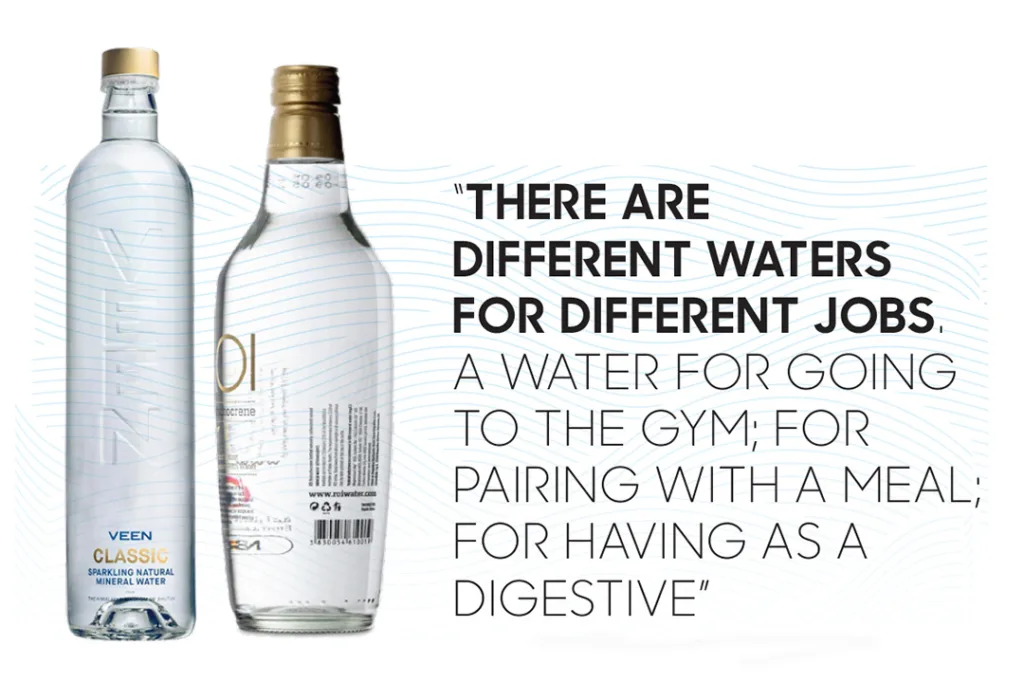
“People can be shocked when they taste different waters, when they forget about things like hydration and just focus on flavour,” he enthuses. “This isn’t to say we should all be drinking exotic minerals waters all the time. There are different waters for different jobs—for going to the gym, for sipping from a wine glass, for pairing with a meal”. He’s now busy developing a canned mineral water, designed to look like an energy drink, “because natural water basically is an energy drink,” he reckons.
Indeed, much as wines are appreciated for their terroir—each one, it’s accepted, is the product of specific soil, climate and agricultural practices—the same is true of water. Depending on the land, some have a naturally high oxygen content or notably fine bubbles for a light, barely there sensation in the mouth. Others have a high level of calcium, which gives the water a creamy richness, whereas a high silica content gives it a smoothness. Waters vary in their levels of salinity and overall minerality, measured in TDS or Total Dissolved Solids. Distilled water would rate as zero parts per million. Some mineral waters might rate at 30,000 parts.
“There are waters I look forward to at the end of the day. I’m not a big chocolate fan but there’s one water, teamed with chocolate, that’s just incredible,” says Binder. “And there are others that I don’t like at all but I still drink them, as a digestive aid, because they’re especially high in magnesium. They’re a tonic”.
One such water might be ROI, out of Slovenia, with one of the highest mineral counts on the market— at 7600mg per litre in a market in which waters over 1500mg are considered high. The company says you’d have to chug 160 bottles of San Pellegrino to get the same mineral goodness.
ROI is so mineral-rich, in fact, such that it has become the choice of many professional athletes, who down their daily 500ml bottle—at the equivalent of AED110 a time.
“Those that can afford it become lifelong customers of ROI,” says CEO Rok Budja. And those lucky enough to get hold of it: ROI can’t draw its water over the hot summer months—because the heat solidifies the magnesium—and is restricted by the Slovenian government to an annual draw of just 24m bottles.
“That’s a big number but when it means only 60,000 people can have one bottle a day, it’s not such a big number,” Budja laughs. “And it’s still a hard market. We focus on functionality, but often people see water and see the price and can’t put the two together”
It’s fair to say that the mineral water industry came close to shooting itself in the foot with a range of over-hyped products whose massively inflated prices were largely down to the fact the water came in cutglass, crystal-covered bottles, or contained gold flake, or something silly akin to that. The ludicrous prices were part of their twisted pitch as a status symbol: ‘look at me, I’m paying a small fortune for water!’.
One brand even called itself Bling H2O. But, according to Michael Mascha—the founder of the Fine Waters Academy and probably the industry’s most vocal campaigner — demand for so-called ‘designer’ waters has faded, not least “because people reacted to them with growing skepticism,” he says.
“Now the focus is back on the water as water, priced to reflect its origin, albeit with the story still part of it all, in the way knowing where your wine is from and how it was made all adds to its appeal”. That means that while there are still extremes, the market tends to top out at around an average AED220 retail—that makes it an affordable luxury, unlike many wines.
If that still sounds like a healthy profit, the mineral water business is actually a challenging, high volume low margin one. “Over the years the mineral water market has had a bad rap because many people haven’t understood the difference between purified water—taken from the tap, treated and effectively dead—and water drawn from particular spring, well or source, untouched, with all of its natural properties intact, so the latter has come across as relatively very expensive,” explains Aman Gupta.
Gupta is co-owner of Veen Waters, a brand founded around a source in Finland and later moving to one in the pristine environmental region of the Bhutanese Himalayas. There it leases land and, in order to protect the longevity of the source, is also permitted by government to draw only a certain amount of water per annum.
“Thanks to prices—simply a reflection of the cost of sourcing the water, often from far away, putting it in a beautiful bottle, freighting it [at huge cost] and then retailers marking it up to cover their costs—the public perception may be that mineral water is a luxury product,” he adds. “But you have to sell a lot of water to make money”.
“A bottling plant is as expensive for a small family start-up as it is for a multi-national,” observes Pat Eckert, water sommelier and founder of Fine Liquids, which operates a water museum in Meckesheim, Germany. “Sure, a premium water can cost a lot of money but there’s usually a good reason for it—not least that the bottler is also, in part, a custodian of the source. They protect it. While it’s inevitable that we’ll have more and more processed water—because we’re using more of the Earth’s freshwater supply, and because of the problem of micro-plastics—maybe in time what will come to define a ‘premium’ water will be that it comes from a carefully protected source”.
Jamal Qureshi is an entrepreneur who was at the front of that first wave of ‘designer’ mineral waters, launching the now dormant Svalbardi brand in 2017. He charted an arctic expedition vessel, sailed into the Norwegian arctic circle, sought out the purest iceberg he could find and brought home 10 tonnes of ice, which was then melted and bottled. At around AED350 for 750ml, it was one of the most expensive waters in the world.
“The price, the bottle, the water, the environmental message—all were wow factors and got all sorts of media attention,” Qureshi recalls. “But what market was there for it? The challenge was to make it a product of aspirational luxury. Most of our customers were not super-wealthy but middle-class, who recognised it was a lot of money for water but that it was a special water for a special occasion or gift”.
As it turned out, when Svalbardi’s bottle supplier defaulted, the company couldn’t raise the capital to keep going. “Then as now there’s a real dividing line between water brands that succeed and those that don’t—and that’s down to financial backing,” insists Qureshi. “It’s a harder business than people realise, especially since the barriers to entry are so low. A giant like Nestle or Coca-Cola, or any other water, they’re all threats”.
Given these challenges, does mineral water have a bright, bubbling future? Certainly there’s still plenty of room for growth. One argument has it that those markets long inundated with water options leave little room for growth while those more used to tap water will be hardest to turn. But there are other parts of the world—like much of the Middle East—where the general lack of abundant ground waters has made the building of a potable tap water infrastructure uneconomic and so where the drinking of neutral bottled waters is habitual. They’re ripe for being nudged into an appreciation of mineral waters.
Enter the likes of Eira, an award-winning water with its source in Norway but which has recently relocated its head office to Dubai in the expectation of the Middle East becoming its biggest market, thanks to its plethora of high-end hotels bars, restaurants and beach clubs. Its water is low in TDS—so won’t overwhelm a local palate not yet used to ‘stronger’ waters—and comes in a minimalistic bottle so, global marketing director Jad Asaad makes no bones about it, looks good on the table. Eira is already the official water partner—yes, there is such a thing—of the Michelin Guides for UAE, Qatar and Abu Dhabi.
As for the many other markets around the world… “Put it this way,” says Michael Mascha. “Twenty years ago nobody was talking about mineral waters being a big business. And now I’m approached by private equity people once a week”.
The fact is, he contends, there are major global trends in favour of mineral water’s ascendancy: the steady decline in alcohol consumption, especially among younger people; there’s the focus on wellness—especially in the face of a global food system many people consider to be broken; and because, Mascha contends, we’re more ascetic—gone, he says, are the days of the ‘five martini lunch’.
But then why should all this mean we don’t just drink, say, more diet soda rather than mineral water? Here’s the point. While mineral water can make claims to being better for you than distilled or purified water, if only for its mineral content, the fact is that a decent diet will provide all the minerals you need, as points out Marion Nestle, professor of nutrition at New York University.
There may have been far-ranging campaigns about the importance of hydration too. But water holds no special property that makes for better hydration over any other liquid, excepting alcohol, coffee and other diuretics. In fact, drink too much purified water and you can end up flushing important minerals from your body. Perhaps there is a spiritual aspect to water—it’s the stuff of life. But what ultimately sets mineral water apart, as we’re slowly learning, is more readily appreciated as matter of experience.
“A Coke is a commodity. Order one in a five-star restaurant and it’s the same Coke you’ll get from the convenience store down the road. You can’t say that of mineral waters,” Mascha argues. “There’s no ritual to be had around a soda. But each mineral water comes from a unique place and is special in its own right. It gives something to talk about. It sits alongside wine in terms of the epicurean experience. And it’s good for you”.
The story is important too, of course. The fact that the water on your table came from a particular ancient spring—or was even harvested from an iceberg—is part of its appeal. After all, “there is no such thing as ‘the best water in the world’, much as it makes no sense to speak of ‘the best wine in the world’,” says Aman Gupta. “The water in itself stands apart. But what captures the imagination is marketing and story-telling”.
What will prove the tipping point, Mascha argues, is when the hospitality industry gets properly on board with this story-telling. He will happily rail against beverage and bar managers—“lazy, stupid”—who are seeing wine sales drop off but are not providing customers with an alternative, even given the higher revenues water would provide, with, no doubt, an initial social media bounce to boot.
Besides, beer, coffee, bread, salt—plenty of products once considered commodities have gone craft. Why shouldn’t water be regarded as a more artisanal product too? “When I was in the United States in 1999 as a German I was thinking, ‘you call that beer?!’ But that whole sector then underwent a massive change. So why not water too?” asks Martin Riese, a water consultant and judge, with over 400 varieties in his private collection, and the man who devised what may have been the first ever water menu, for the LA Country Museum of Art, back in 2012.
There is, he concedes, much for this new market to work through. “Water sommelier? I get how that sounds completely pretentious,” he laughs. “I’m more just a thirsty guy”.
He has a problem with some so-called premium waters, he says. And putting purified tap water in a bottle and selling it is, he reckons, “just a scam”. So-called ‘smart’ waters? Don’t get him started on that snake oil. “The brands that do that kind of thing need to be called out, because they leave people skeptical of all waters,” he says. “This is all a question of education.
And in time many more of us will have the same kind of appreciation for water as we do other fine things in life. It’s happening. And soon”.