
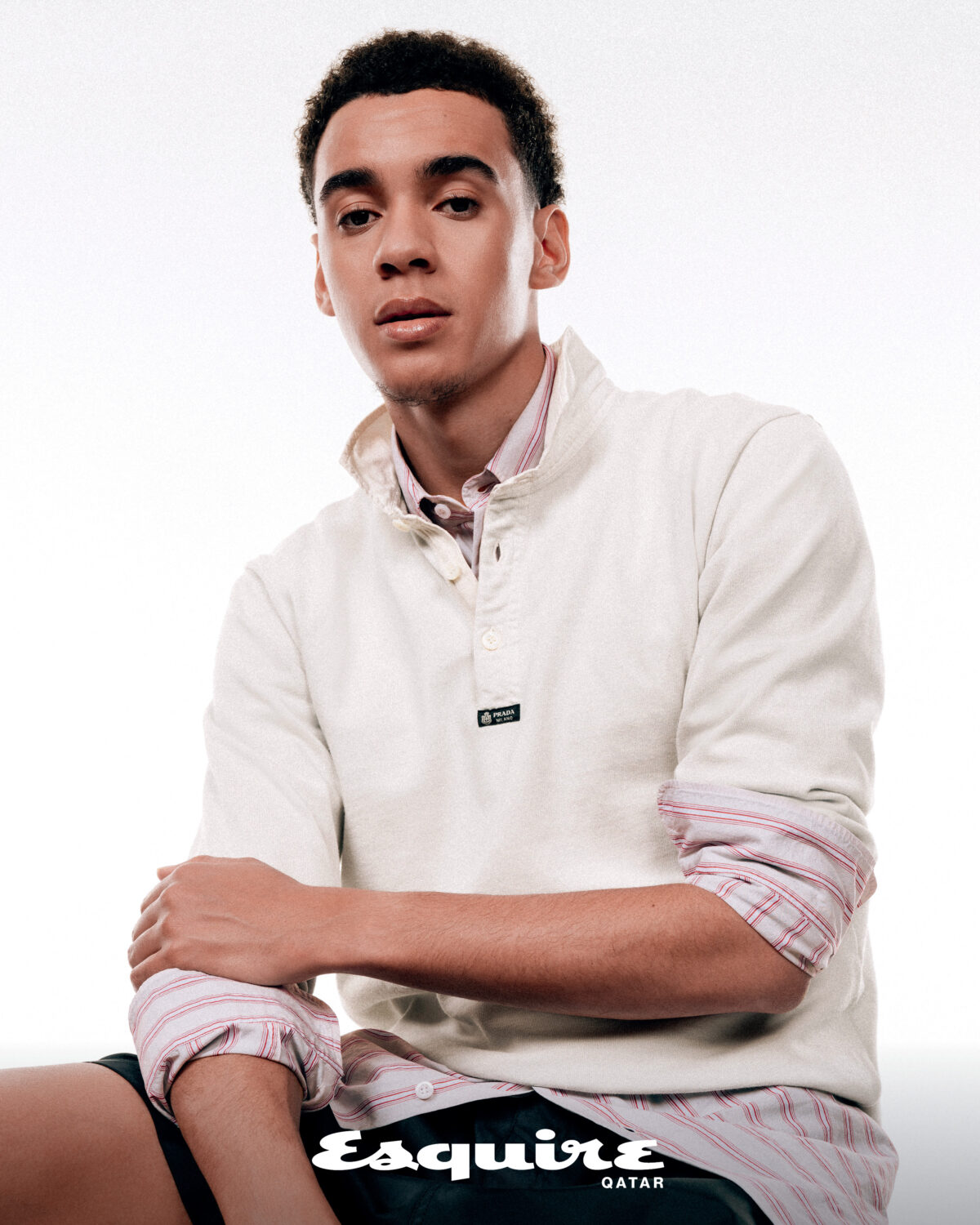

The quintessential modern football star — technically brilliant, intelligent on the pitch, and a bona fide difference-maker. Despite a brutal injury that threatened to rule out his entire season, he worked on his comeback with a meticulousness and determination way beyond his years. Now, the FIFA World Cup is all set to be his comeback stage.
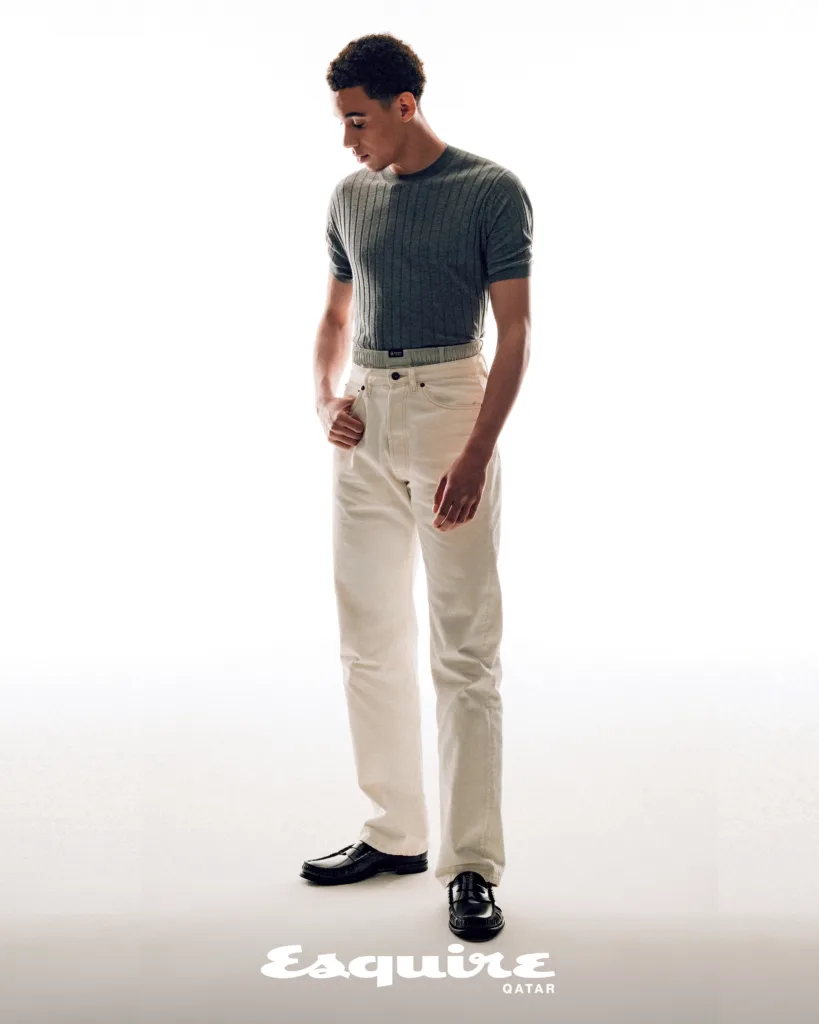
Jamal Musiala can draw a crowd. Whether it is on the pitch for perennial winners Bayern Munich; leading the line for the German national team; as the new face of the Prada Paradigme fragrance; or even in a photography studio in Munich on a weekday morning. But it has been a testing year for German football’s wunderkind. The 23-year-old has fought his way back from an eight-month injury just in time to play in the World Cup in North America and, as he tells Esquire, the work he’s been putting in during his time away might just make him even better than ever…
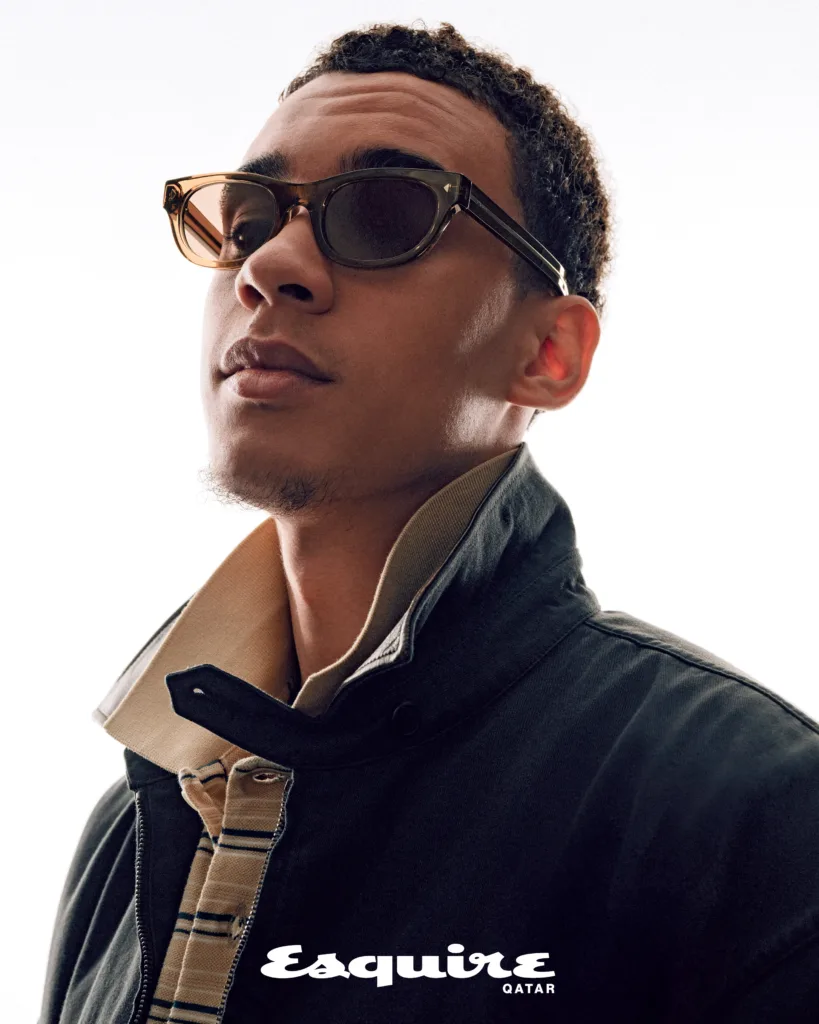
ESQUIRE: Jamal, all eyes are on you! Are all the expectations and pressures—including doing photoshoots like this one—still strange, or are they now just part of the job for a star footballer?
JAMAL MUSIALA: Yeah. It’s now part of my job but, honestly, when things go well, I enjoy it. And when things go really well, I can clear my head on days like today. That, in turn, is good for my game, because it allows me to bring that clear head with me on to the pitch. It’s important to have other things in life that bring you joy besides football.
ESQ: There are a lot of brands that want to work with you. You took your time, but now you’ve chosen Prada Beauty. How did that come about?
JM: I followed a feeling about what might suit me and what really resonates with me. I liked the energy and so far everything is going very well.
ESQ: Did you smell the Prada Paradigme fragrance before or after you signed the contract?
JM: Definitely before! My whole family and friends knew the fragrance. I thought that was important.
ESQ: We know a lot of people who work for Prada. They are the kind of people that take their work very seriously, but still have a lot of fun. Does that sound a bit like you?
JM: That’s exactly how I would put it. You have to go onto the pitch, recognize your task and take it totally seriously, but at the same time, you must never forget why you chose to play football in the first place. In my case, it’s because I truly love this sport so much.
ESQ: Today, athletes have to live life in public with people openly commenting on how you played; what you wore; where you ate… Do you enjoy it or is it frustrating?
JM: A bit of both. I like to withdraw and be by myself. But publicity and fame are also exciting. My life would be completely different if I weren’t a footballer. I’m happy. My trick is perhaps that I always try to give back positive energy. I really appreciate the love people have for me, and so I try to always stay true to myself while at the same time allowing myself to continue developing as a player and public figure.
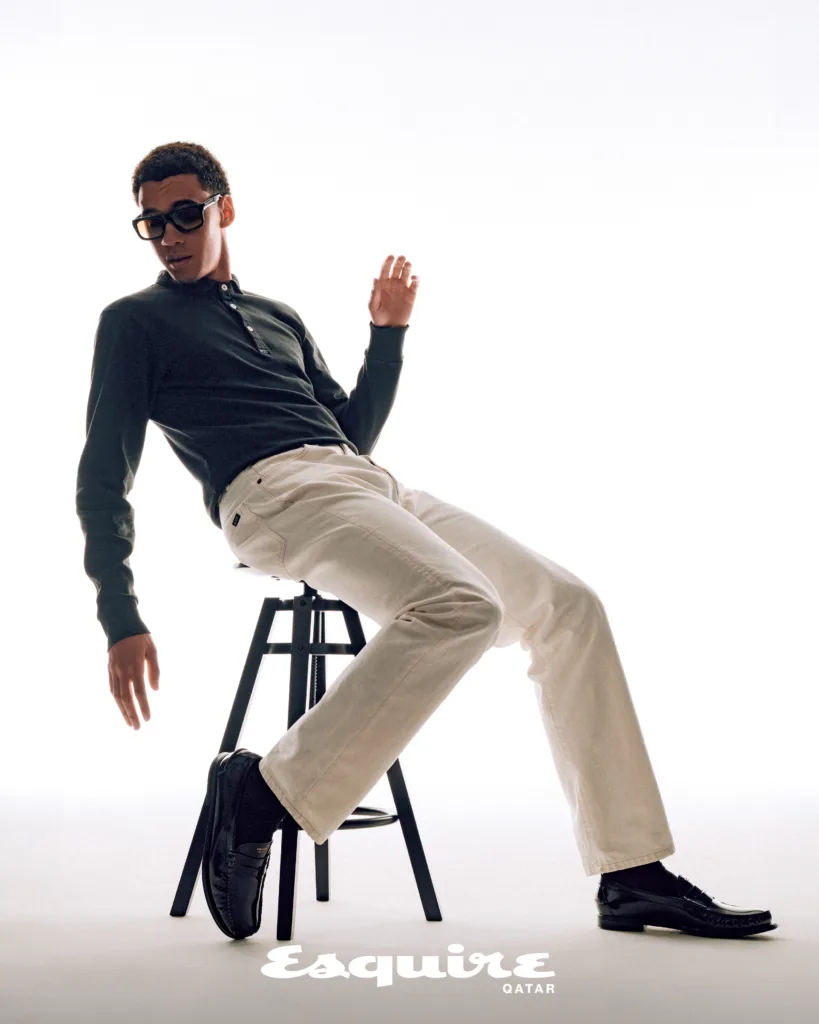
ESQ: You are a role model for so many people, especially for kids and particularly for young boys. And now you’ve also written children’s books, in very simple language, totally accessible. Was it especially important to you that the books are made for absolutely everyone?
JM: That was absolutely crucial. My mum and I had been talking about it for a while. I’m happy that the books have now been published. They’re about what I’ve learned on my journey so far, literally: “What I’ve Learned”. I wanted to inspire young people in an extremely understandable way. I definitely want to continue in this direction; it’s a good way to give something back.
ESQ: “What I’ve Learned” is a phrase we know well here at Esquire. So tell us, what is the most important thing you have learned?
JM: Tough question! There have been many over the years. The three most important things to me right now are: try to see the positive in every situation; never lose the joy in what you do; and try to stay on the light side of life, even when you get into tough situations.
ESQ: Speaking of which, you were in an extremely tough situation at the beginning of the season, with a horrible ankle injury and breaking your fibula. Staying positive must have been a challenge…
JM: It was, but I had to, and I’ve never learned so much in a single year. Returning to the pitch seemed endlessly far away. All the negative thoughts, the mental chatter: none of it helps you get one step closer. You have to get that out of your head as quickly as possible. So, in a way, my job was to try to feel joy again. First in the gym, then in rehab, then back on the ball. And suddenly, time passed much faster than I had initially feared.
ESQ: You’ve used mental coaches, physios, and dozens of others around you, but in the end, of course, you have to do it on your own. Which tools did you try?
JM: All of them.
ESQ: All of them?
JM: I read books; I talked to experts and to friends; my mum was incredibly important. In the end, it was always most helpful to get the thoughts out of my head. Somehow, I even managed to preserve the positive aspects. That helped me on this long road. I’m a different person on the pitch than I was before the injury.
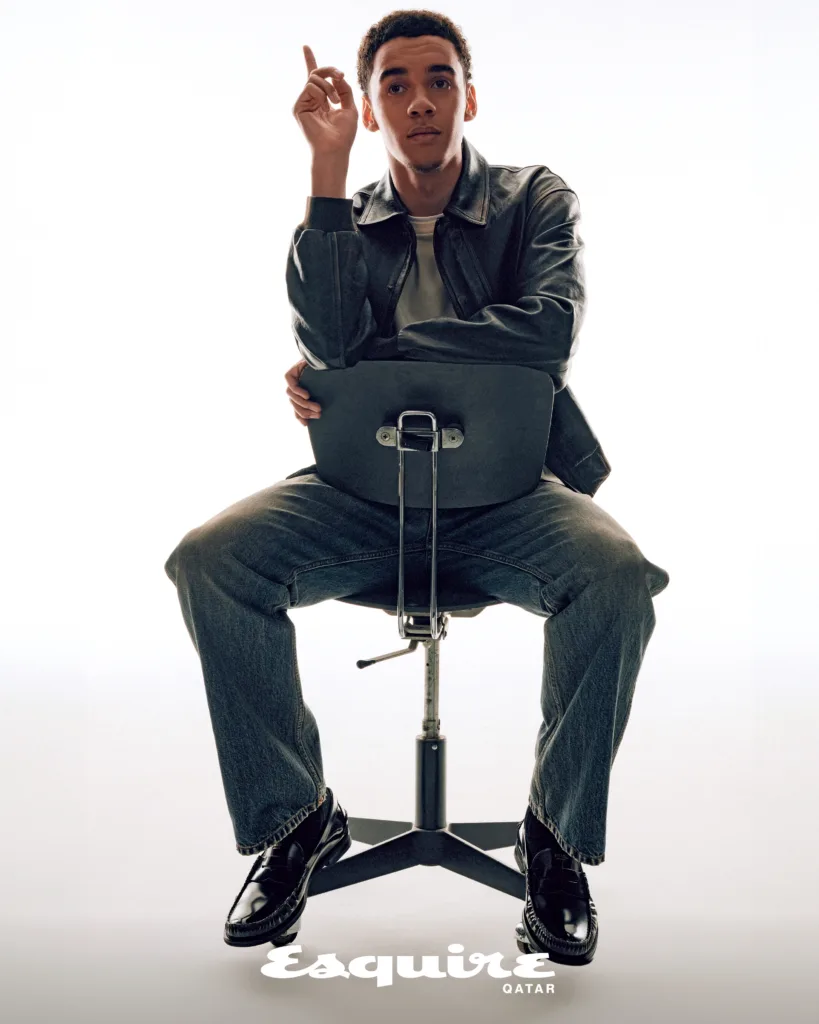
ESQ: In what way?
JM: At some point, I realized the injury period was the perfect time to think everything through: What kind of player am I? What kind of person am I? And how can I come back as a better player and maybe even a better person? And enjoy everything a little more, too.
ESQ: Sounds as difficult as it is healthy. Was the bigger challenge mentally or physically?
JM: Hard to answer. Physically, it’s incredibly tough to regain self-confidence in your own body and trust your foot. Then rebuilding your fitness and putting even more pressure on your foot.
ESQ: And mentally?
JM: Psychologically, it’s not easy either: getting your mind back on track, internalising the conviction that you’ll come out of this better and stronger. If you’re not convinced of that, you can work on the physicality all you want, but both aspects need equal attention, otherwise they’ll hold each other back.
ESQ: Did you re-watch some of your old games? Only the gems or also the duds?
JM: Both! If I was feeling happy one day, I took the opportunity to analyze games where I wasn’t so confident in myself. I was interested in what was going on mentally or why I wasn’t technically up to par. I couldn’t get on the pitch, but I still wanted to learn something about myself on the pitch. And when I was feeling down, I watched games where I was happy on the pitch, so I wouldn’t forget who I used to be. Among the good games were definitely my first appearances at a World Cup.
ESQ: You were a bright spot in 2022 and played like a young dog in Qatar. What did you take away from your first World Cup experience and what do you expect from your second?
JM: I was really young, and super hungry so I went into it with a totally positive attitude. At the same time, I was completely nervous and wanted to show everything I could do. I was actually quite happy with how I played. I was able to take a lot of lessons from it, for example, the mindset needed for a month-long international tournament is completely different from playing a regular season with your club, which takes place on a weekly basis and follows a certain rhythm.
ESQ: Is playing in the World Cup the greatest experience for a player? Or would you say it was playing in a Champions League final?
JM: Both are great, but the World Cup is the most important tournament you can experience as a player. The huge responsibility, the motivation to make the fans proud, the fact that it only happens every four years. A lot can happen in four years, so you can’t take anything for granted—you can see that with me. In any case, I’m incredibly excited about it, and all the players feel the same way, so nobody really needs to worry.
ESQ: As players, you are de facto representatives of your country to the world. What message do you want to tell the world about Germany?
JM: We want to show who we are. On one hand, we want to show the quality we can bring to the pitch when everything comes together well, while on the other hand, it’s also the vibe and the energy that defines our country and all of us. Above all, the hunger to win.
ESQ: The American expression “It’s not your first rodeo” seems fitting here. Does it feel different because it’s not your first World Cup?
JM: Definitely. The fact that I’ll be going into the tournament as a different person because of the experiences I’ve had also comes into play. I’m really curious to see how that will translate to the pitch.
ESQ: Do you ask older players who already have a few World Cups under their belts for advice? Manuel Neuer and Thomas Müller, for example—or do you tell the senior players: ‘get out of the way, it’s our turn now!’
JM: I’m someone who always, always, always asks for advice. Not so much in terms of mentality, as everyone is different and needs different impulses at different times, but in almost all other matters. I like to challenge my own attitudes and I’m open to anything that will help me develop as better a player.
ESQ: This German team is such a young one, including the coach [Julian Nagelsmann] and many of the key players like you and Florian Wirtz. Could you become the young heart of the team?
JM: I hope so. We have many young players who bring real quality to the pitch and can help each other. That’s also incredibly important to me: being there when support is needed most. There’s a great deal of trust within the team.
ESQ: The importance of ‘trust’ was shown in 2014 when coach Jogi Löw substituted Mario Götze on in the final after a mediocre tournament. Apparently he told him: “Go and show the world that you’re better than Messi.” And then Götze scored the winning goal. Is that something only a great coach can pull off?
JM: It’s an important skill for a coach to be open to letting his players play with freedom, and allowing them to go out there and do what they do best. That’s sometimes what players really need. I’ve had so many great coaches, and each does things in their own way. I can’t say often enough how important it is to have a clear head.
ESQ: How do you clear your head? During the photoshoot, it looked like music is your thing…
JM: I love music. It is so versatile, so you can find a soundtrack for every situation. Every song has its vibe and can be exactly what you need. But sitting in complete silence can also be good for you. When in doubt: meditate.
ESQ: Would that be the advice to your twelve-year-old self: Learn how to clear your head?
JM: Yes, that would be my advice. But also, I’d tell him to stay hungry, but don’t be too hard on yourself. Don’t stress yourself out so much!
ESQ: What stressed twelve-year-old Jamal out so much?
JM: Everything.
ESQ: Everything?
JM: Everything. Was I good enough on the pitch? Did I score enough goals? Do I need to train more? The pressure has, to some extent, made me who I am today, but I was incredibly hard on myself. So, I would tell little Jamal to be kinder to himself.
Credits
Words by Dominik Schütte
Photography by Sebastian Gabriel
Styling by Rebecca Glavurtic and Jean-Claude Empassy
All Clothing by PRADA
Digital-Tech: Matthias Somberg
Make-Up: Angelina Marrandino
Hair: Teodora Wongo
Light assistants: Sebastian Resch
ProduCtion: Jennifer Perlick