

Sometimes innovation can be in the things that you rarely notice. It creeps in at the edges, hiding in some small design tweak or quiet technical shift, until suddenly you realise the whole landscape’s changed. But TAG Heuer’s latest creations don’t bother with that subtlety. They’re bold, precise, and slightly audacious in all the right ways.
A month ago, the brand took on Dubai Watch Week with a stand-alone booth for the first time, using the moment to introduce the TAG Heuer LAB — the innovation hub now responsible for some of the most striking engineering it has ever introduced. And from that lab came the TAG Heuer Monaco Split-Seconds Chronograph Air 1.
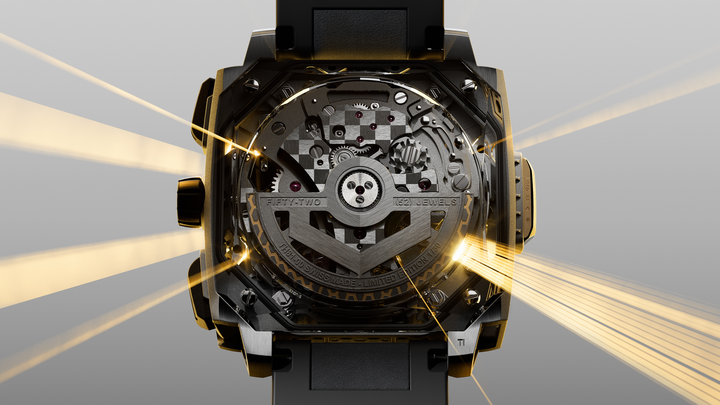
At first glance, it barely seems real. The 41mm case appears hollowed out, almost skeletal, the sort of thing you’d expect to find in a hypercar paddock rather than on a wrist. That’s down to Selective Laser Melting (SLM), a manufacturing technique borrowed from aerospace, medicine, and motorsport, then re-engineered by the TAG Heuer LAB for watchmaking. Instead of carving out a case from a block of metal, SLM builds one, layer by impossibly thin layer. The result is Grade-5 titanium shaped into fluid, muscular lines and latticed contours that look like they were dreamt up in a wind tunnel.

Even with solid gold elements woven into the form, the watch weighs just 85 grams. That includes the twin-layer honeycomb-motif mesh around the movement, the Grade-5 titanium bezel coated in black DLC, and the laser-cut 2N yellow-gold lattices under the bezel. It’s a level of complexity that demands time: programming takes around ten times longer than for other Monaco Split-Seconds models, while manufacture takes roughly five times longer still. But the payoff is a case that simply couldn’t exist without SLM. As TAG Heuer’s chief executive, Antoine Pin put it, the process allows an engineer to deliver “a watch designer’s wildest creation,” rewriting the usual limits of case design.
Inside the futuristic shell sits something equally serious: the Calibre TH81-00. It’s TAG Heuer’s most complex chronograph movement, a high-frequency automatic calibre developed with Vaucher Manufacture Fleurier. It beats at 36,000 vph, has a 65-hour power reserve, weighs just 30 grams thanks to Grade-5 titanium components, and carries a rattrapante function capable of timing two simultaneous events. The movement is finished with the brand’s signature checkered-flag motif, visible through a full sapphire caseback. Only 30 individually numbered pieces will be made.
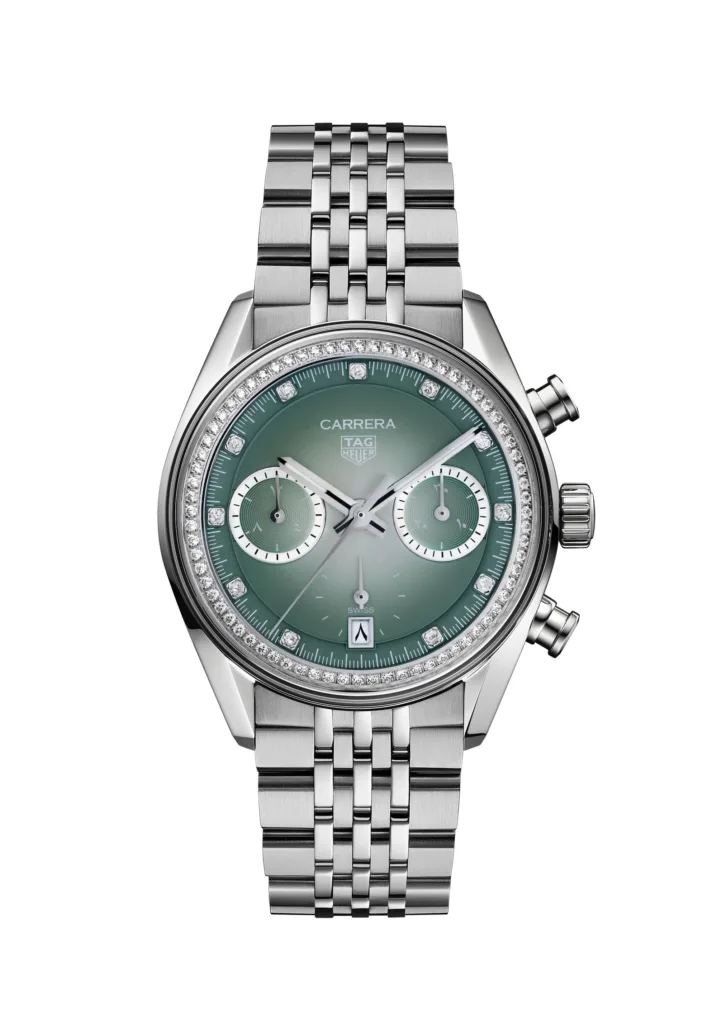

Yet the Air 1 wasn’t the only head-turner unveiled. TAG Heuer also introduced two limited TAG Heuer Carrera Chronograph Middle East Exclusive Editions — one designed for men, one for women — each created to honour the region’s heritage and innovation. Both run on the in-house Calibre TH20-00 and feature smoky green sunray dials, but each takes its own aesthetic route. The men’s model pairs its olive-toned face with rose-gold accents and a steel bracelet, limited to 400 pieces. The women’s edition, limited to 200, elevates the emerald dial with 72 diamonds on the flange and 11 diamond indexes.
Together, these releases signal a shift in how TAG Heuer imagines its next era — not bound by traditional constraints, not chasing nostalgia, but pushing into new territory, full throttle. With the TAG Heuer LAB now shaping the brand’s most ambitious ideas, and with boundary-pushing timepieces like the Air 1 setting the tone, TAG Heuer isn’t just updating its playbook; it’s rewriting the rules entirely.