

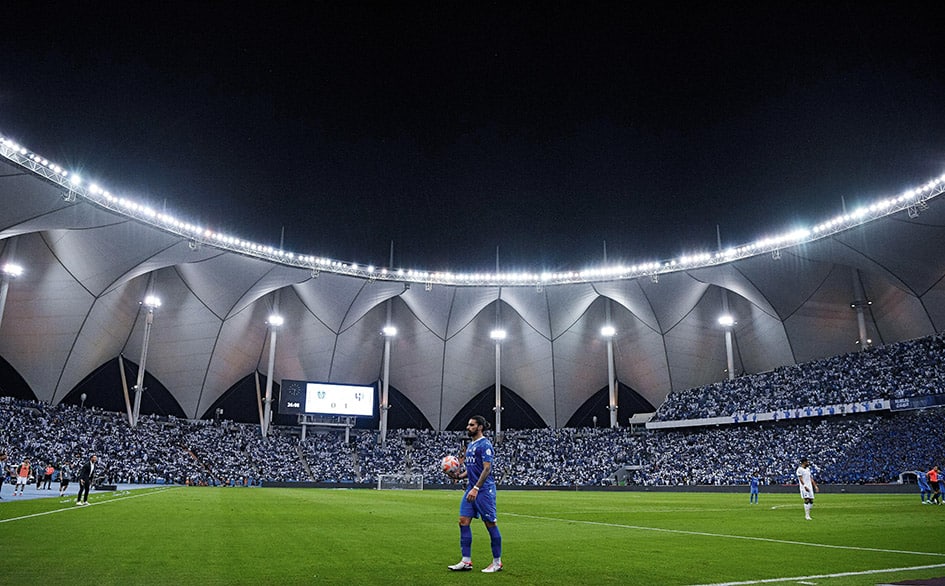
Across an entire stand of the King Abdullah Sports City stadium stretches the image of a yellow and black fist, directed ominously towards the away fans. It is the first Jeddah derby of the 2024-25 Saudi Pro League season and Al-Ittihad’s supporters are keen to intimidate cross-city rivals Al-Ahli.
The giant mosaic, better known worldwide as ‘Tifo’—the term for artwork created by football fans—is not the only tool in Al-Ittihad’s arsenal.
Soon the noise begins to build as nearly 50,000 fans strive to build a wall of sound, hoping each decibel created will directly translate to an extra yard for their heroes on the pitch. Al-Ittihad need to win the match. Not just for local bragging rights (much needed after losing twice to Al-Ahli last season), but to keep the pressure on league leaders, Riyadh’s Al-Hilal. This is Saudi football at its best; a patchwork of passionate fans doing all they can to drive their team forwards.
Jeddah’s two biggest clubs share a stadium but for today’s match it is Al-Ahli who are the designated ‘away’ team. Among those in the ground’s only all-green stand is 27-year-old Talal Afandi, a club photographer for Al-Ahli.
“I have supported this club all my life and to me, Al-Ahli means passion,” Afandi tells Esquire Middle East. “My father made me love this team and now I do too. Our fans are very creative—with chants, songs and Tifo. These things can be game changers for the team and there is a lot of competition between supporters to show who does it best.”
On this November night, it is Al-Ittihad who triumphs—winning 1-0 thanks to a goal from Saudi national team striker Saleh Al-Shehri. The stadium erupts and the home fans burst into song; Afandi and the other Al-Ahli supporters have been silenced.
Around the world, football offers a valuable window into a country’s culture. The Kingdom is no exception, which is why the Saudi Music Commission recently included the sport in a wide-reaching project aiming to comprehensively catalogue the nation’s music. ‘Saudi Trouq’—the initative’s name—began with a focus on the Kingdom’s penchant for folk music, before football chants were later added as a sub-category.
“Football in Saudi Arabia is an incredible passion point,” Paul Pacifico, CEO of the Saudi Music Commission explains to Esquire Middle East. “Music didn’t used to be accessible in big public gatherings so singing for your team at a football match was one of the key ways people could create moments of communal expression.”
Partnering with UNESCO, the Saudi Music Commission has recorded chants and songs from clubs across the Kingdom—each stadium uncovering a clean sheet of new material. The mass participation element of singing in stadiums is something that particularly fascinates Pacifico.
“Something very special happens in choirs, when large groups of human beings come together and sing,” the Englishman says, who has played his instrument of choice—the harmonica—for more than three decades. “It is a unique and special experience. There is something quite intangible about it that we don’t understand.”

With football such a well-established part of the Kingdom’s social fabric, Saudi Trouq set out to identify the nuances of chants between different cities and regions.
“There is a real poetry to it here,” Pacifico explains. “Football chants in England tend to not be very complimentary or polite whereas in Saudi Arabia, they are often more lyrically rich.
“But it is also a reminder that humans everywhere gather to share passions and banter between competing communities. It’s a reminder of the universal nature of human spirit and comradery.”
On the same weekend as the Jeddah derby, Saudi Arabia’s capital also plays host to a cross-city rivalry. In Riyadh, 19-time champions Al-Hilal have long-ruled the roost over rivals Al-Nassr, with not even the great Cristiano Ronaldo able to reverse that historic trend. As the Kingdom’s most successful team, Al-Hilal unsurprisingly boasts a substantial—and ever-growing—fanbase.
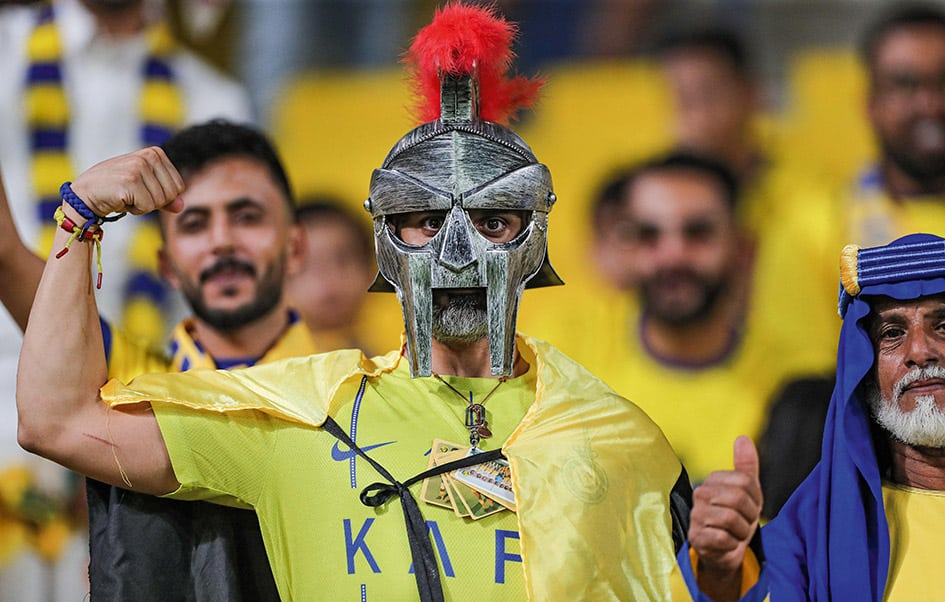
Playing a key role in keeping those supporters’ spirits high during matches is ‘The Blue Power’—a group dedicated to generating new chants, songs and Tifo. Riyadh resident Osama Al-Obaid is one of its founding members.
“I have been an Al-Hilal fan since I had a brain to think with,” 24-year-old Al-Obaid beams when asked about his club. “The Blue Power team is responsible for letting the players know that the fans have their back. It’s what gives the spirit to Al-Hilal.”
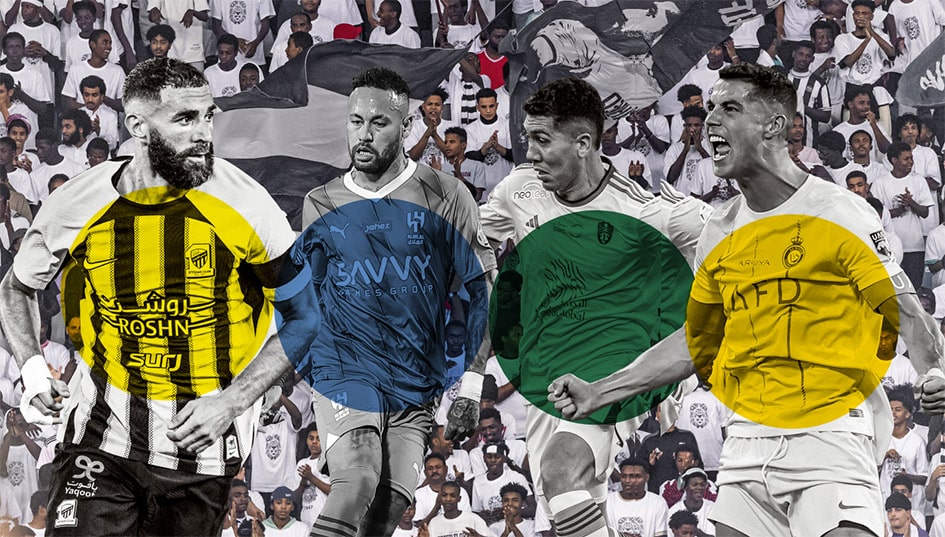
Al-Hilal has had a major influx of foreign stars in recent years, with the likes of Brazilian icon Neymar Jr., Ruben Neves and Aleksandar Mitrovic making high-profile moves from Europe to the Saudi Pro League. It has been a welcome test of The Blue Power’s creativity.
“We have some chants about the club but of course we make some up for individual players,” Al-Obaid explains. “There is one for goalkeeper Yassine Bono, which we sing in a Moroccan dialect to recognise his heritage. And we have ‘Mitro is on Fire’ [to the tune of ‘Freed From Desire’ by Gala] for Mitrovic. It is not about trying to recreate European football chants—we draw inspiration from our own team and experiences.”
Back at the saudi music commission, the Saudi Trouq project has been finalised after many months of painstaking work. For Pacifico, whose first real taste of Saudi football culture was seeing the national team beat Argentina in the 2022 FIFA World Cup, the results were eye-opening.
“It would have been a really important piece of the jigsaw missing if we hadn’t documented and recorded football chants as part of this process,” he says. “Football chants deserve the same respect in terms of cultural significance that we’ve given to other forms of longstanding folkloric culture in the Kingdom.”
Pacifico has personally witnessed the King Abdullah Sports City Stadium at its cacophanous best, attending last season’s King’s Cup final in Jeddah. Live football, he believes, is not just a ticket to a sporting event, but an opportunity to better understand the soul of Saudi Arabia.
“Saudi Trouq has really helped us connect the dots between traditional culture that has really ancient roots in the peninsula and the search for the contemporary Saudi voice.
“What is clear is that no place on the planet has jurisdiction over fan culture and chanting. Here in the Kingdom there is definitely a very unique Saudi flavour to the way the people approach football chanting. It is a powerful, fantastic and rich medium.”