
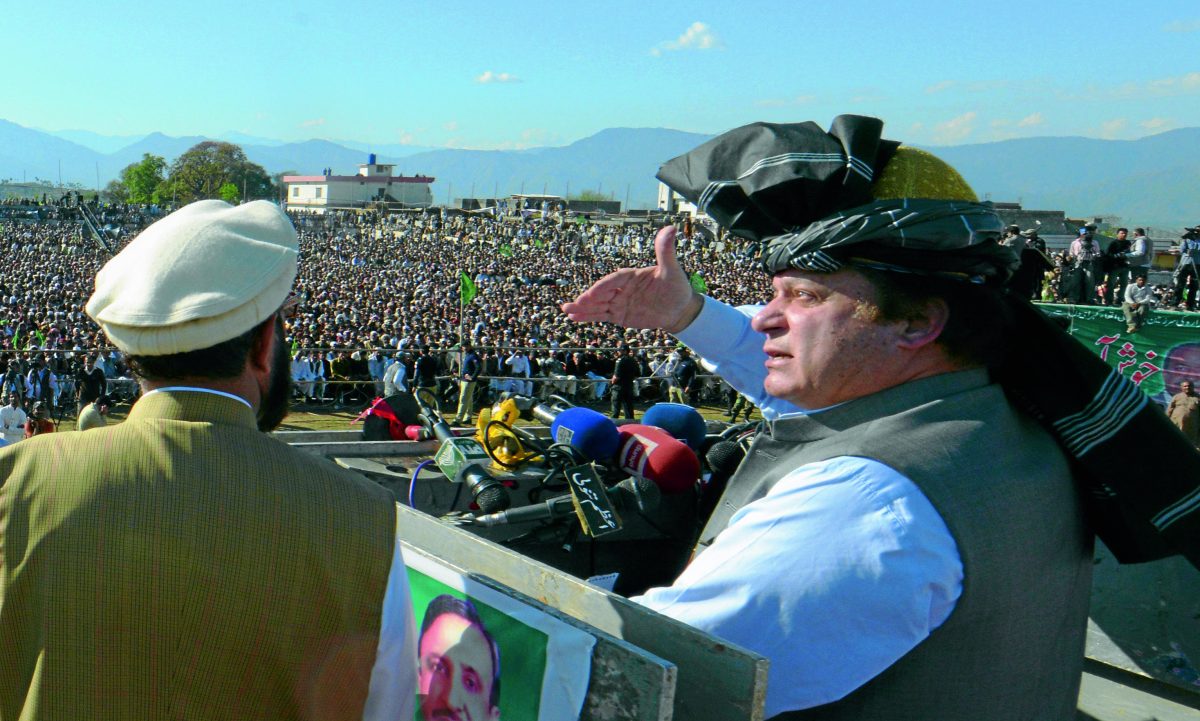

To Pakistan, December 2013. The country is virtually unrecognizable from the beleaguered nation of a few months earlier, when the May general election brought cricketing superstar, philanthropist and icon of a new Pakistan, Imran Khan and his Tehreek-e-Insaf (PTI) party, marching to a landslide victory.
Within ninety days of taking office, Khan has, as he had relentlessly promised over the past two years, radically turned the country around. Two months before the election, he had articulated a new pledge,
“Naya Pakistan”(“New Pakistan”), setting out a six-point contract of trust for the Pakistani people.
I will never lie to the nation.
Me and my government will wage a “Jihad” against injustice in the country.
I will keep all my wealth in Pakistan, I will not be like other leaders who rule in Pakistan but keep their wealth abroad.
I will not take or allow others to take unfair benefit during PTI’s tenure in the government.
I will guard the nation’s tax. It will not be spent on Governor, PM and CM houses. The PTI government will break the walls of the Governor houses.
We will stand by overseas Pakistanis.
Within days of assuming power in May, the PTI had begun implementing drastic reforms, ranging from anti-corruption measures in government infrastructure, to dealing with international relations and resolving the tangled mess that was the home-grown, U.S.-backed “war on terror”.
Today, in December 2013, American drones no longer bomb Pakistani villages, as they have been doing since 2004, when the Bush administration began targeting militants and al-Qaeda fighters (killing at least 400 civilians according to Islamabad’s
own records).
“I dreamt of making Pakistan the best cricket team and winning a world cup; it took ten years and we won in 1992. I dreamt of establishing a great cancer hospital, it took five years and Shaukat Khanum Memorial Cancer Hospital was created. I dreamt of a university like Oxford; I set up Namal University. When I joined politics, I dreamt of Pakistani people rallying with me for a better Pakistan and on October 30, 2011 the tsunami took over Pakistan”
The Pakistani government’s previous compliance with the U.S. had resulted in a disastrous cycle of violence between the Pakistani military, the CIA (which was violating Pakistan’s sovereignty, according to Islamabad) and the seemingly indefatigable tribesmen warriors in the FATA and NW Frontiers. But today, after negotiations with Khan’s administration, the Pakistani Taliban and al-Qaeda factions have stepped back from hostilities, warily accepting Khan’s personal apologies for the years of bombardments and assurances that long-term negotiations will secure them stability, safety and prosperity.
Imran Khan is also addressing head-on, the volatile situation in the Balochistan province, by ending state-backed military violence against Balochi separatist forces. He has instigated a dialogue with leaders of the beleaguered region, promising to formulate a “new package” for his “Baloch brothers”, who have long been at odds with the Pakistani establishment over rights to natural gas revenues, provincial autonomy and appropriate representation.
Meanwhile, Pakistan has put an end to the Faustian pact with the United States, by rejecting all American aid. The annual receipt of billions of dollars, most recently enshrined in the 2009 Kerry-Lugar-Berman bill, which saw a tripling of U.S. “developmental” assistance to Pakistan to $7.5 billion over five years, has been stopped – much to the relief of all concerned. Khan has instead instigated a fiercely-austere program of social welfare, designed to rebuild essential infrastructure in the country and ensure that taxes are redistributed throughout the population, benefiting those most in need as a matter of priority. He has assured the nation that the reformulation in spending will benefit everyone in the long term.
As longer-term programs are launched, reforming education, tackling unemployment, restoring infrastructure and developing renewed confidence and independence in Pakistan, the country is on
the road to one day becoming a sylvan haven of tranquility;
a progressive, self-sufficient society with Scandinavian degrees of transparency. A reinvigorated population is for the first time in decades – indeed, since the country’s birth in 1947 – embracing a leader genuinely committed to altruism, the greater good and the Pakistani people. Today, in December 2013, Imran Khan is enjoying a colossal public mandate. And to approving noises domestically and around the world, he is moving purposefully towards a future of prosperity and stability.
Back to reality, late summer 2012, and the man who believes he can fix Pakistan, now sits stiffly in his seat, amid the opulence of a villa in Dubai’s Emirates Hills. I am here to interview him, with a photographer in tow, which does nothing for his mood. Scowling politely, preening a touch, barely concealing his irritation, Imran Khan is enduring the tedium of yet another “informal” photo shoot. I really can’t pose for these things he grimaces as Esquire’s photographer cheerily asks him to move, smile and shoot his cuffs. Does this have to go on for much longer? The camera clicks relentlessly and with a weary professionalism, borne of forty years in the public eye, the fifty-nine-year-old reluctantly rises to the occasion, flicking from sporty-casual to mature and intense, a flicker of a smile and he changes again to… well, statesmanlike.
Statesmanship is a concept that Khan has been getting used to of late. Although he launched the PTI back in 1996, his popularity has surged massively in the past couple of years. Today, in membership terms, the PTI is one of the world’s largest political parties, claiming ten million subscribers. An estimated five million of this number is comprised of expatriate Pakistanis.
But it is in the country itself where the upswing has been most pronounced. During 2011 and 2012, in the doldrums of the creaking Zardari PPP administration, the PTI began attracting freakish levels of public acclaim. This manifested itself at rallies around the country, which saw colossal crowds, unprecedented since the days of former president and prime minister, Zulfikar Ali Bhutto, in the 1970s. The masses would turn out to hear Khan’s hoarse, passionate exhortations for change and fervent promises of the same.
As the numbers grew into hundreds of thousands, Khan referred to this groundswell of public support as a “tsunami”. In October 2011, 100,000 supporters attended a rally in Lahore. A few months later, in December, 250,000 gathered in Karachi. That year, his public support was pegged at a seventy percent by the Pew Research Center. The previously far-fetched scenario of a Khan presidency was no longer such a remote possibility. Had snap elections been called during 2012, it’s fair to say that a defeat might have been the greater surprise. Khan had found his stride.
Prior to our interview in Dubai, we’d met in Davos back in February 2012. His confidence was almost through the roof, probably still riding high from recent record-busting attendance
at his rallies.
For the first time we have a movement of real scale; it’s far bigger than was ever seen in the 1970s. We’ve never seen anything like this in my country; it’s almost like a dejected people suddenly sees the light. This tsunami effect is gaining momentum day by day; it is unstoppable and it will wipe out the status quo. And they are all getting together, the main political parties are getting together against us, they’re scared of this phenomenon. Until recently, it was like musical chairs; they were protecting each other, they would go to a certain point and not push as they didn’t want to destroy the status quo. Now they are seeing a force coming, they feel under threat and they all want to get together. But, whatever they do, they can’t stop it now.”
When Khan told me this, it seemed as if there was nothing stopping him, such was the momentum of public support. Fired up by his glamorous image, anti-corruption stance and stern foreign policy rhetoric, he seemed as powerful as any of the other titans of world affairs, assembled in the snowy hills of Switzerland. But, in the bloody, unpredictable world of Pakistani politics, nothing is ever that simple.
When Khan formed Tehreek-e-Insaf, he was dismissed by many as a simplistic and reactionary, crowd-pleasing one-man band;
a Ron Paul figure destined to coast harmlessly in the afterglow of his two decades in cricket. Refusing to bow to his sceptics, Khan’s characteristic blend of dogged persistence, fantastic powers of self-belief and unrivaled international profile slowly began to assume credible form, exacerbated by Pakistan’s own slide into chaos. His cavalier approach to personal hubris also helped, with a penchant for distinctly grandiose rhetoric. For example, at a recent Swat valley appearance, in March 2013, he channeled Martin Luther King…
I dreamt of becoming world’s best all-rounder. In nine years time I became one. I dreamt of making Pakistan the best cricket team and winning a world cup; it took ten years and we won in 1992. I dreamt of establishing a great cancer hospital, it took five years and Shaukat Khanum Memorial Cancer Hospital was created. I dreamt of a university like Oxford; I set up Namal University, though it is just the beginning for the institution. When I joined politics, I dreamt of Pakistani people rallying with me for a better Pakistan and on October 30, 2011 the tsunami took over Pakistan. Four months back,
I dreamt of Pakistanis celebrating in the streets and I realized PTI had swept the general elections.
It’s easy to dismiss Khan as a fantasist – and many do. His untested political record, coupled with a penchant for grandiloquent statements and an air of unassailable righteousness, lays him open to regular charges of naivety and bombast. This has led to a narrative emerging in the domestic and international media, warily assessing Khan’s credentials as a potential statesman.
 The re-energising of former Prime Minister Nawaz Sharif’s campaign of late has also put the onus on Khan to revive his early 2012 momentum, which has slipped badly in recent months. The Washington-based International Republican Institute conducted an opinion poll in January that put Khan’s party on eighteen percent – well behind Nawaz Sharif’s thirty-two percent, although above President Asif Ali Zardari’s fourteen percent.
Khan, according to his critics, tends to whine when things don’t go his way. He blames the same shadowy conspiracies of Pakistani “liberals” (whom he loathes, citing the perceived Pakistani middle class malaise of ‘Westoxification” as an especially sore point), along with rival politicians. He is non-committal regarding his relationship with the army, which has raised more than a few eyebrows among the electorate, the military being crucial to the stability and success of any potential leader.
All of this – the overconfidence, the vagueness on detail – has probably contributed as much to this recent decline in fortunes as much as it propelled him to popularity. Yet perched on his chair in Emirates Hills, eyeing the departing photographer with relief, his passion and commitment to his cause is undimmed by any recent slump in the polls.
Let me tell you what is happening in Pakistan… People are so sick of these old politicians who are all in power. The only reason they’re not taking to the streets is that they know at elections they’ll beat them. If they [Asif Ali Zardari’s Pakistan People’s Party] think they are going to rig the elections, there will be bloodshed.
In 1977, Zulfikar Ali Bhutto tried to rig the elections, which created the circumstances under which the army, [headed by] Zia ul Haq came in. But this will be multiplied hundreds of times if they try and do this now. Because people are now fighting to survive. Half our population is struggling just under the poverty line. There are gas shortages, there’s high unemployment, inflation and corruption on an unprecedented scale. So, if they think they are going to rob the people of this election, there will be real trouble in the streets. There have never been free and fair elections in Pakistan. And we are going to use our street power and the Supreme Court to ensure this happens.
Aside from bombast, the other main charge leveled at Khan is that he could never hope to follow through on his bold promises of leading dispirited Pakistanis into the sunlit uplands of stability and prosperity. In other words, he doesn’t have any real policies. Not so, according to the man sitting opposite me now.
Our number one [priority] is this war on terror. You have to have an immediate ceasefire, and then truth and reconciliation with the people of our tribal areas. Win them over to our side and use them. When you announce a ceasefire, it ceases to be jihad. Conservative people in the tribes believe that anyone fighting jihad is doing God’s duty. But when a new government comes in, they will talk to us and there will be no more jihad.
His critics argue, of course, that fixing decades of paramilitary conflict and unrest is not something that could ever conceivably happen overnight. But Khan warms to his theme.
Then, you pull the army out [of federally-administered tribal areas] and tell them to take care of the hardcore of militants. I believe this could be done in ninety days…
[Suddenly explodes angrily]
Argh, it’s so s***! They [the U.S. and the Pakistani army] bombed villages! It’s one of the most shameful parts of Pakistan’s history along with what we did to east Pakistan – our own army, killing our own people. Therefore you have to compensate them. But they are hardy people and when the new government comes in, then they will talk to them – they won’t blame them. And our party is by far the most popular party in the tribal areas. So, from day one, a ceasefire. Then start talking about withdrawing the troops. The moment you talk to the tribes and start dialogue – there’s no more martyrdom, jihad or suicide attacks.
There is also the small matter of India. All of the regional flash points – Afghanistan, Kashmir in particular – are bound in with the agonized relations between the two countries. Khan has addressed this issue before, telling CNN in 2011: “I have no prejudice against any country, and more specifically, India.”
But rather than outline any details on how that relationship might be repaired, there were more cricketing analogies. “I can give my best shot. I can fight to the last ball. We can only try.”
The second key issue, as outlined by Khan, concerns the U.S. aid sent to Pakistan, which totals more than $1 billion annually. Resented by American taxpayers, unseen by most ordinary Pakistanis – thanks to the murky accountability of the ruling elite – Khan believes freeing Pakistan from Western aid packages is crucial to rebuilding national autonomy and freedom.
There has to be a policy from now on of no more aid. All aid has done is stop us making the reforms we need to balance the budget. Aid has just fed that crooked, ruling elite, while the poor people have had no benefit. So we would have a total dismantling of this elitist way of life. They [the ruling politicians] are living like Mughal emperors! It’s shocking! This VIP tiny elite, hogging the country, living in palaces, travelling in private jets… And the country’s bankrupt! It is on the brink of collapse. Health and education budgets have been cut just to feed this war. It’s total insanity. So, from day one, there will be an austerity campaign, meaning living frugally and making people realize that their taxes won’t be going to corruption. And that’s the only way we’ll earn the people’s trust.
Trust is Khan’s most sure-fire asset. In a country as cricket-crazed as Pakistan, his two decades as a superstar of the game
was eclipsed only by his fierce integrity. This quality, seemingly scarce in Pakistani public life, came to the fore again when he began fundraising for what would become the Shaukat Khanum Memorial Cancer Hospital & Research Center, which he opened in Lahore in 1994 in memory of his late mother. By traversing the country and appealing to donors worldwide, Khan raised $25million for the hospital, which offers free treatment for all those who need cancer care. Today it has emerged as a benchmark in healthcare in the region. Khan also began tapping up acquaintances from the Pakistani diaspora and his wealthy celebrity contacts to fund the PTI, endlessly demonstrating his scrupulous financial accounting.
I was always going to be able to collect funds. I already had a network of people. Anyone who wanted to fund the hospital would also want to fund the party. They can see the PTI as being the only party that can get Pakistan out of this mess, so why would they not fund it? I’m the only politician people trust with their money. Politically, I will only collect money on a project-to-project basis.
I won’t keep collecting money for party funds because that would be a disaster. If you want to destroy a party that’s how it starts.
Imran Khan has always enjoyed a colorful, undulating relationship with the Pakistani people and global political commentators. His playboy image in the 1980s – the London nightclubs, the glamorous women, the jet set lifestyle at the height of his athletic career – has all been revisited endlessly by critics, eager to poke holes in his re-found sense of piety. Similarly, his nine-year marriage to British socialite, campaigner and journalist Jemima Goldsmith (which ended amicably, according to both parties, in 2004) continues to provide fodder for conspirators and disgruntled hardliners. They have long asserted Khan to be in the grip of a Jewish conspiracy, a Zionist confabulation orchestrated by his ex-wife’s late father, Sir James Goldsmith. Jemima wasn’t even Jewish, he sighs when we talk of his past. But that’s irrelevant – it sort of fitted what they [his political opponents] wanted, so they blamed her. And they still blame her today.
Yet Khan’s public profile as the all-conquering cricketing hero never waned. History is full of sporting or entertainment stars who have felt the lure of politics, but Khan gives the impression that parlaying his extraordinary appeal with the Pakistani public into a more substantial mandate for reform was almost a foregone conclusion. Given his options – a cosseted retirement in his thirty-seven-acre farm near Islamabad or a benevolent, philanthropic role – it’s unsurprising that he would reach for the higher calling.
What distinguishes a leader is the ability to take responsibility in a crisis, whether it’s a country or a team. If the leader capitulates, that’s when everyone goes down. With the crisis Pakistan is having now, you must have this ability to stand and take pressure. You have to find solutions and make decisions. And that’s when the leadership comes in. People ask me, ‘Are you worried or scared?’ Not at all! Throughout my life, I’ve faced pressure. If there’s one individual who has faced more pressure than anyone in the entire political spectrum, it’s me.
The PTI was founded with a manifesto for sweeping change: empowerment for the Pakistani people, wholesale reform of local and regional government and a reconfigured foreign policy. But nothing much happened for some years. In the 2002 general election, the PTI won only 0.8 percent of the popular vote, though Khan did become MP for the constituency of Mianwali, his ancestral hometown. In 2007, after years of increasingly outspoken criticism of General Musharraf, he resigned from Parliament along with a number of MPs, in protest at Musharraf’s refusal to stand down as army chief and contest elections as a civilian.
Having been placed under house arrest, Khan escaped and turned up a few weeks later at a student protest rally at the University of Punjab. There, instead of receiving a warm welcome in the bosom of the country’s future generation of voters and lawmakers, students from the conservative Islamist political party, Jamaat-e-Islami, bundled him off to the police station, and turned him in, describing his presence as a “nuisance”.
Dr Saeed Shafqat is a professor and director at the Center for Public Policy and Governance in Lahore and also the author of a number of internationally-acclaimed books, on Pakistan. Striking up a lively email correspondence with him, I ask for his opinion on Khan’s policies and plans for power.
“I admire his sincerity and passion for change,” replies Shafqat. “In my mind, he remains one of the greatest cricketers of his time. [As a politician] he is certainly popular in certain segments of Pakistani society, particularly in parts of central and northern Punjab and Khyber Pakhtunkhwa. However, there is general skepticism about his political acumen and bargaining skills. He should really be thinking of a limited but effective opposition role.”
That, clearly, is not the role Imran Khan wants, even though rival parties have pushed back into the lead after being momentarily taken aback by Khan’s brief but vast public appeal. His inexperience and political youth is also seen generally as a hindrance. Conversely, Khan views the same issue from the opposite perspective.
I’m clear in the sort of team I want. The team will have to have a touch of experience and youth. But you can’t have just young people. Not just anyone can walk in and govern. You need experienced hands too. And I will select the best. And if I am clear on my vision for change, only those people will be part of my team. Because I can’t be blackmailed; I am not a career politician.
His main opponent, Nawaz Sharif, is neither young – sixty-three – or inexperienced, having ruled Pakistan from 1990 to 1993, when he was forced to resign, and from 1997 until a military coup d’état ended his second government in 1999. This time around he is promising, in rather alarming terms, to parallel his successful nuclear tests in the late 1990s with imminent “economic explosions” that will make Pakistan a powerhouse of economic energy. He is also, through the Punjab state, offering laptops to gifted students to foster academic achievement. One could argue that the scheme will gently encourage them to see Sharif’s point of view. Cheekily, Khan recently countered this by suggesting students take the laptops and vote for the PTI.
More blatantly, the PML-N has recently built a Rs70 billion ($700 million) bus-metro service over the congested streets of Lahore, much to the public’s delight. And Sharif may not be alone in pulling last-minute rabbits from hats. President Asif Ali Zardari has finally launched a $1.5 billion pipeline project from southern Iran, which could, once operational, provide much of the energy currently lacking in Pakistan, where power cuts and shortages are a part of daily life. Killjoy cynics have pointed out that Zardari only pushed for the pipeline in the final days of his presidency – much to the anger of Western governments who see it as a flagrant breach of Iranian sanctions. The consequences of firing up the pipeline could be severe for Pakistan, endowing the country with yet another less than copacetic legacy of the Zardari era.
Khan is, of course, aware of the potential implications of defying the U.S. over the pipeline. He is also repositioning Pakistan away from its malfunctioning role as a “key ally” on the War on Terror and energy is fundamental to this new approach.
The biggest problem is the energy crisis in Pakistan. It is going to de-industrialize Pakistan. We discovered huge amounts of coal in 1992. Pakistan has the third-biggest coal reserves in the world. But what they [the then Government] did was to make money on these independent power stations. They were getting commissions that distorted the whole balance. Instead of being based on coal or hydro, they changed to furnace oil, which is imported. And so as the price of oil went up and the rupee fell, electricity became so expensive that our industry just couldn’t compete. And it crushed the people, it led to inflation. In the short and medium long term we have to switch to coal and gas – we also have this – and hydroelectric power.
The energy crisis is a key factor in the elections. Khan will face the potential positive and negative consequences of the Iran-Pakistan pipeline (if it ever actually really launches – there have been several such false alarms in the past). He must also counter some serious competition in the form of Nawaz Sharif’s PML-N party, which administers the Punjab region, Pakistan’s most stable region when it comes to energy. Keen to point to his party’s track record in tackling the energy crisis regionally, Sharif is only too happy to make it a central plank of his electoral strategy.
Khan’s policy rhetoric acknowledges the long-term nature of the energy crisis, but his short-term solutions, when questioned on the specifics, again return to his anti-corruption theme. He emphasizes the need for professionals, not agenda-driven politicians, to make decisions.
It needs a very clear thought-out policy. Governments have always operated on short term policies, no one has thought what happens long term, in the future. No one is paying attention to that.
 Nawaz Sharif was, of course, deposed the second time around by Khan’s other great rival, the recently re-animated Pervez Musharraf. Having returned to Pakistan following an exile in London and Dubai, Musharraf had, at time of writing, just been remanded in judicial custody over claims he illegally detained judges in 2007.
Musharraf’s perceived compliance with the American government, with regards to the War on Terror, remains raw in the minds of many Pakistanis. When the prospect of co-operation arises, Khan bats the question away impatiently. If the elections proceeded fairly and he was asked to work with someone like Pervez Musharraf, would he consider that proposal?
No, no, not at all. I would stay in opposition. Let me put it this way. Even if there was a chance to join a coalition and to get into power and this coalition happened to be part of this status quo,
I would much rather stay in opposition.
Placing Khan on the political spectrum is a tricky business. He supports liberalized economic policies, devolved power, a welfare state and a diminished role for the military in public life. He re-embraced Islam in the mid-1990s. A significant chunk of his support comes from right-wing voters. Dissenters claim he is in thrall to the military or the Taliban – which isn’t likely, given the Taliban’s public grumblings about him.
“He is largely perceived as a traditional, conservative type of leader, whose rhetoric is anti-American, anti-corruption, sympathetic to the Taliban and not very clear on issues of gender, human rights and welfare economy,” avers Shafqat. “But he has energized the election campaign and initially was able to mobilize the youth. However, his subsequent candidate selections considerably compromised the initial thrust and momentum. It is most likely he will win between twenty and forty seats, but the chances of a massive electoral sweep remain limited. However, his party’s participation will enhance the credibility of the democratic process.”
Pakistan might appear to be a country perennially on the verge of crisis, but some sort of landmark was halfheartedly celebrated this March, when Asif Ali Zardari’s Pakistan People’s Party clocked up a full term in office. Remarkably, this is the first time in Pakistan’s history that any administration had completed a mandated five-year tenure, without being prematurely toppled by a coup, be it civilian or military.
Yet even the most optimistic of commentators couldn’t but help acknowledge that, even by Pakistan’s standards, what the outgoing administration offered in longevity, it clawed back via unprecedented lows in incompetence, corruption and chicanery. Khan is adamant he can redress the imbalance from the outset.
The recent figures released by the government are shocking.
In four years, the Pakistani economy has lost $50 billion in this war on terror. The total amount of aid in that time has been $20 billion. So this war has cost four trillion rupees and you bear in mind our total annual tax collection is under two trillion, so imagine what we could have done with that money. And our debt has doubled in four years, from six to twelve trillion. And just the cost of corruption and tax evasion, according to Transparency International, was 8.5 trillion rupees over four years. My objection was the War on Terror. Now they’ve quantified the cost. My objection was that the rich don’t pay taxes. They’ve quantified that again. If you deal with these issues you can make Pakistan viable.
 With just a few weeks to go until the election, Khan is thinking big: the PTI recently announced that it will field 767 candidates for the elections – only eighty-two short of the total number of seats. Most are new faces. His critics will say this once again highlights the inexperience of Khan’s party, but he sees it differently. Imran Khan believes – passionately – that he represents the change that Pakistan so desperately needs. His policy team has also been hard at work fleshing out ideas since we spoke, as evidenced by his website. Also on his site is full accountability for the party, reinforcing his “whiter than white” approach to financing.
But will that be enough? Does Khan represent a wishful ideal that will elude reality yet again? Or will his time come, but just not yet?
Given his righteous ire and frustration at the status quo, the consensus remains for now – a decent, well-meaning man in an impossible situation. Whether he can channel his frustrations and dreams into a viable solution for Pakistan in the 21st century will become clearer this month.
By Arsalan Mohammad