
Space isn’t so much the final frontier, but rather a modern day Gold Rush.
While tech start-up poster boy Elon Musk’s company SpaceX is making gradual progress on infrastructure that could significantly reduce the cost of sending resources (and at some point, people) into orbit, even more grandiose plans are afoot much closer to home.
At last month’s Dubai Airshow, not only did the space sector feature significantly — with exhibitions, conferences, and speakers that included former NASA Apollo 15 astronaut, Al Worden — but it was also the setting for the country to announce its next, ahem, moonshot.
While the UAE Space Agency’s intention to launch a Mars probe in 2020 is already well-known, the latest announcement of plans to grow tomatoes (and date palms) on the red planet demonstrates a whole new level of ambition.
“There are similarities between Mars and the desert. The landscape of the UAE, the soil, are similar,” Rashid Al Zaadi, senior strategic planner at the UAE Space Agency told media at the airshow. “Well, when we get there, we’ll have to eat.”
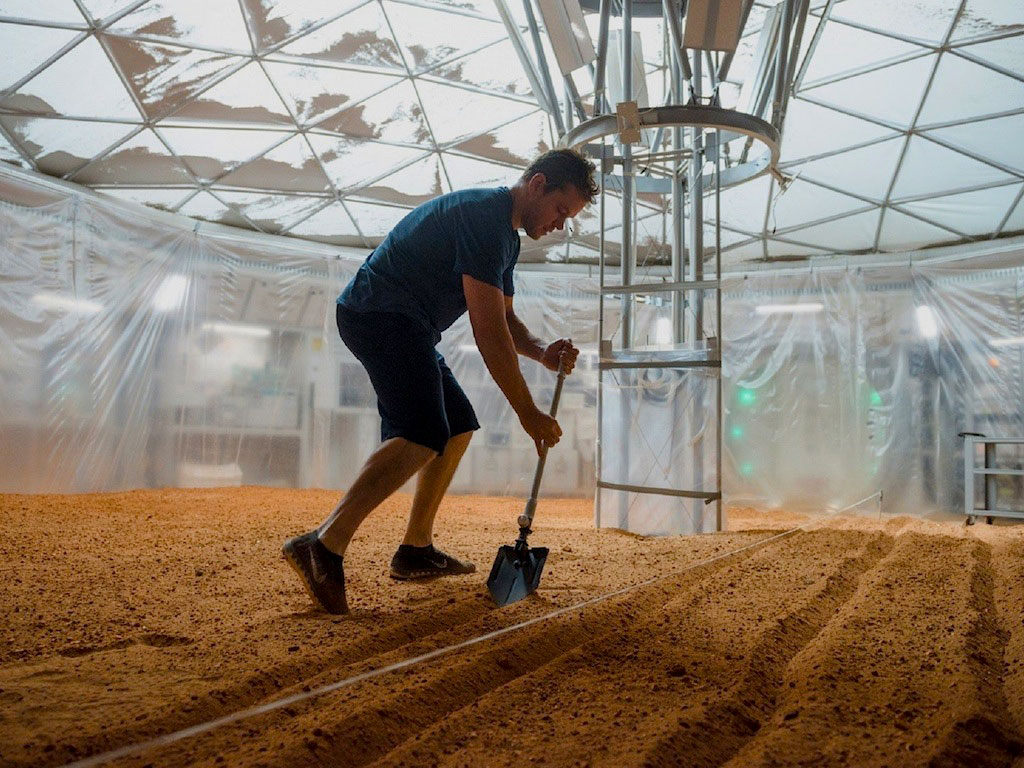
For the actual science aspect, it might actually be possible to grow food on Mars. The Wageningen University in The Netherlands has spent four years experimenting with Martian soil simulants and procedures in an attempt to mimic the atmospheric conditions of the planet.
Bought from NASA, the researchers have been using soil from a volcanic cone in Hawaii, which is as close as they can get to a soil with similar Martian properties, short of flying over to the planet, scooping some up and bringing it back to Earth.
However, despite having been able to harvest the crops — peas, potatoes, rye and, ahem, rocket — the question now is whether they would be safe to eat, considering high levels of lead and mercury.
It’s fair to say, that any interplanetary work is rather expensive. Since the UAE Space Agency was set-up in 2014, the country has invested approximately AED 20 billion in its Mars project, according to the BBC. That includes a Mars probe, a final full-scale mock-up of which was unveiled at the airshow.
The UAE has also begun work on its Mars Science City, a centre dedicated to studying the colonization of the planet. The series of domes in the desert, with two million square feet of living space and research facilities, will investigate food, water and energy needs.
While the world has grown rather accustomed to the UAE’s limitless ambition, there is actually a simple economic reason for its continued investment in the space industry.
The country is keen to transition away from any economic dependence on oil and tourism (and the associated services and engineering), and instead towards growth in the science and hi-tech sectors, which would provide new jobs and future-focused skill sets.
With approximately 100 million young people in the Gulf region, the UAE’s latest grand idea is as much about growing tomatoes on Mars, as it is about growing its own sustainable future.
* Tomatoes are a fruit
Get the Esquire Newsletter. Click here to sign up