
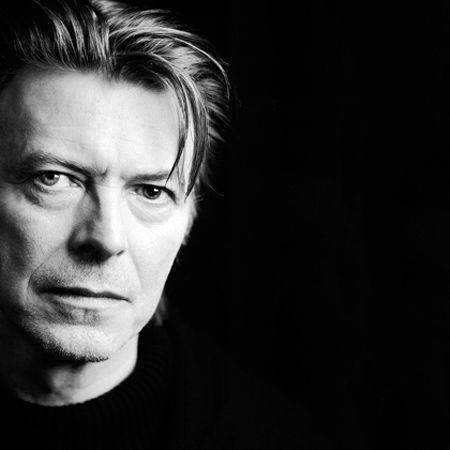

On January 8, 2016, two days before David Bowie died, I went to Hansa studios in Berlin’s Potsdamer Platz. This is where he recorded his masterpiece of alienated electro-art-rock Heroes, back in 1976. There, I stood with friends and about 200 hundred Bowie fans of varying vintage, listening to a playback of his latest — his last — album Blackstar, released that very morning. It was tremendous.
Since his virtual disappearance from the limelight in the mid-2000s after a heart scare, new music from the old maestro had been rightly hailed as missives beaming in from an unknown space, so at odds with today’s hyper-documented world. No-one knew much of what he was up to. Rumours abounded as to his health. But with the release of The Next Day in 2013 and now, Blackstar, we were reassured that, although withdrawn in his Manhattan fastness, the guv’nor was still plotting, scheming, filtering and music-making.
And what music it was too. Blackstar wafted into the Meistersaal studio, quelling chatter and settling over our heads as a lightning-flecked, static cloud. Dense, complex patterns unfurled like thick black smoke from the speakers. Impenetrable lyrics, enigmatic musical motifs, collages of disparate elements wound around skeletal structures, sporadically bursting into starbursts of thrilling freeform sonic adventuring. It could not have been made by anyone else today other than David Bowie — mysterious, dense and, somehow in its disparate chaos, making perfect sense.
Less than 48 hours after the album was released, and two days after his birthday, its maker passed away in New York. He’d been ill with cancer, very ill, and no one outside his small circle knew it. He’d known since last November it was terminal.
David Robert Jones, born South London in 1947, has passed on. But his great creation, David Bowie, remains everywhere
The impetus of impending mortality is the ultimate spur and he had set about this last album — with a band of young, New York avant-garde jazzers — with the knowledge it was almost certainly to be his last. The final chilling promotional videos, filmed when chemotherapy had rendered him frail and weak, his hair falling from his head in handfuls, presaged his death with a chilling, grim theatricality.
Despite this elegant, eloquent farewell, the truth is still stark and brutal. David Bowie is dead? How on earth can David Bowie be dead?
He isn’t, of course. He’s not dead because he was never real. David Robert Jones, born South London in 1947, has passed on. But his great creation, David Bowie remains everywhere in contemporary culture, from art to fashion, literature to theatre.
The legacy he leaves embodies this boundless panoramic vision, a kaleidoscopic universality. His was the first body of work by a pop artist of the post-modern era, a mantle he would increasingly acknowledge as the years went by. He was the intellectual, matey, distant, hilarious, aloof, beautiful, strange, polymath autodidact who intrigued, infuriated, provoked and inspired his followers.
In the days after his death, condolences were posted from characters as diverse as drag queens to the Archbishop of Canterbury. It’s hard to think of another figure whose influence could touch so many hearts and minds in such profound degree.
The success of Davy Jones’ creation was as hard-won as it was brilliant. Success eluded him in the 1960s, as he cast about for a direction that could accommodate interests ranging from Buddhism to Kubrick, Kabuki theatre to Weimar-era Berlin. Jones studied mime, dance and experimental theatre, learning key lessons on presentation, aesthetics and movement. He adored the anarchic screaming of pioneer rock’n’roller Little Richard, whose mad hollerin’ and yellin’ thrilled the suburban teenage Jones to the core.
Eventually, as David Bowie, he found out how to channel these influences into popular culture. He was never a denim-clad ‘authentic’ rocker, which very much against the grain in the early ’70s, but by associating himself with the glam explosion, found vent for his myriad obsessions and inclinations. A magpie mind, his voracious appetite for books, art, fashion, philosophy, history, design, music, aesthetics and so much more, created a heady brew, which constantly impelled him onwards. Rarely, if ever, have chart acts cited Aleister Crowley, Little Richard, Andy Warhol and HP Lovecraft as influences. Gary Glitter he most certainly was not. As he said himself in the song “The Bewlay Brothers” from 1971’s Hunky Dory – ‘chameleon, comedian, Corinthian and caricature’.
Bowie’s innate ability to constantly ch-ch-change his identity and methodology was the key to his success. He possessed an unerring knack for absorbing his surroundings, engaging with everyone who swam into his circle. Bowie was always on — countless peers and colleagues over the years have spoken of his almost supernatural ability to constantly absorb, filter, retain and re-interpret. And this drove him onwards, for fear he would grow boring, stale or predictable. It’s remarkable to consider how, following his years of struggle in the wilderness to achieve fame, once he created a world-beating glam rock persona, Ziggy Stardust, he ‘killed’ him off in a live concert in summer 1973, at the height of his notoriety (and much to the horror of his management, band and record label). Fans, the media and his moneymen were apoplectic, but with staggering nerve, Bowie insisted on moving ahead.
Postmodernism was beginning to gain traction amongst academics and theorists and wittingly or not, the skinny, snaggle-toothed musician became a perfect metaphor for a post-pop sensibility. The wavy-tressed, gender-bending troubadour of 1971’s Hunky Dory morphed into the proto-punk Ziggy Stardust. New York schizo-glam hipster Aladdin Sane followed, then the mooted musical based on George Orwell’s 1984, which transformed into an apocalyptic descent into Diamond Dogs, which preceded the re-invention as a baggy-suited Philly soulboy for Young Americans. The middle of the decade revealed an icy, neo-expressionist Thin White Duke, who shed his monochrome finery to record the monumental ‘Berlin trilogy’ as an austere electro pioneer, before donning the pastel suits and blow-dried quiff for 1983’s mega-selling Let’s Dance. Further personas would include a soberly suited, bearded gentleman playing dismal heavy metal (in Tin Machine) and a leather-clad, spiky-haired sonic terrorist plying drum’n’bass on 1997’s Earthling. The list goes on. Everyone has their own Bowie who is one or more of all the above.
Never one to stand still, Bowie’s career veered between Garbo-esque enigma and almost demented productivity. The BBC documentary Cracked Actor, which followed the emaciated, paranoid star across a tour of America in 1974, revealed a man on the verge of emotional and physical collapse. And much of his subsequent career, from the point he left a drug-addled existence in LA in 1976 to anonymity in Cold War Berlin, was characterised by the recovery from this self-destructive spiral.
Yet, whether throwing soulboy dance moves for Young Americans or lecturing interviewers about the Kabbalah and Satanism (“I’ve got to close the blinds,” he blurted to a startled journalist from Rolling Stone in 1976, “I just saw a body fall past the window.”), the half-educated suburban schoolboy had seemingly known from an early age that he simply had to be a star. How and when it happened was almost incidental.
“I’m not a prophet or a stone-age man,” he sang on 1971’s magnificent “Quicksand”. “Just a mortal with the potential of a superman… I’m living on.”
Even as his days were running thin towards the end of 2015, the singer was constantly obsessing over finding new ideas and forms with which to reflect on the themes that have beguiled him all his career — death, identity, love, art and above all, a deep sense of humanity. There is no one else remotely like him at work today. Forever changing, everything has now changed. He will be truly, madly, deeply missed.
– – –
This article was originally published in the February 2016 issue of Esquire Middle East. To buy a copy, click here