
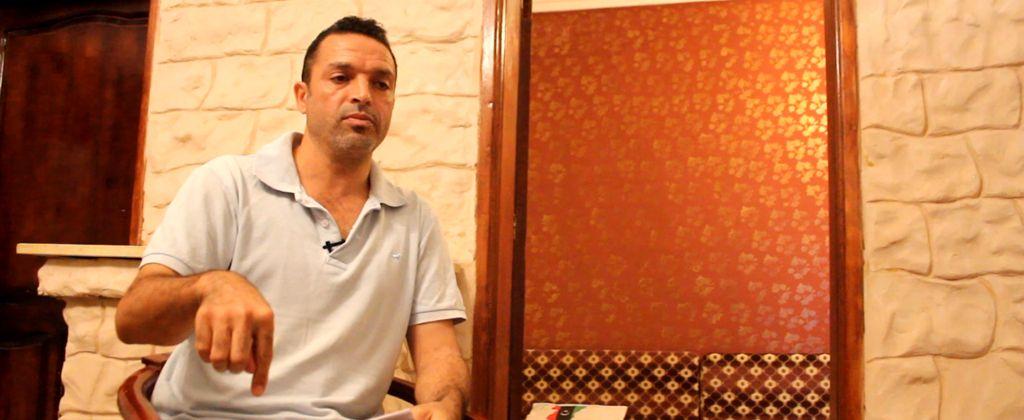

The leader of Libya’s strangest and most daring military operation since the revolution is disappointingly nondescript in person. Abdelmonem al-Said is clean-shaven and seemingly unarmed. Aside from a hard, challenging stare, he isn’t physically imposing and is not even wearing military fatigues or carrying a gun. Instead he’s dressed in a short-sleeved polo shirt and blue jeans.
Nothing about his appearance hints at the extraordinary events two weeks before our meeting. On October 10, al-Said led dozens of men armed with machine guns and rocket-propelled grenades on a successful early-morning raid into Tripoli’s luxurious Corinthia Hotel. They captured Libya’s prime minister, Ali Zeidan, and held him for more than eight hours.
The kidnap plunged an already troubled country deeper into political turmoil, sparking international concern about Libya’s worsening security and out-of-control militias. Zeidan was only released when the base where he was being held was surrounded by a mishmash of pro-government militiamen, army forces and concerned gun carrying citizens – all demanding the prime minister’s release.
In the days following his abduction, Ali Zeidan named Abdelmonem al-Said as one of the men who interrogated him while he was detained and labelled the kidnapping an attempted coup. But when al-Said talks about it he makes it sound like a normal day in the office. “Zeidan is a criminal and I arrested him,” he says with a dismissive shrug, as if he was talking about detaining a shoplifter or a joyrider.
It’s late at night and we’re in al-Said’s sparsely decorated family apartment, located in a in a quiet Tripoli suburb. I’m squeezed on a narrow sofa with my translator, Majdi; al-Said sits across from us behind a cheap coffee table on the room’s only other chair. Eight of al-Said’s men are squatting against the far wall. All are dressed in civilian clothes. They appear to be anxious though unarmed, and watch our conversation with interest.
Abdelmonem al-Said is the leader of a unit in Libya’s Anti-Crime Authority, a police force that comes under the Interior Ministry, but has been accused by its critics of corruption and involvement in criminal activities. We were able to track him down following a tip-off from a friend-of-a-friend, who told us that al-Said wanted to tell his side of the story.
Our hope was that he’d be able to give us some kind of insight into what’s really going on in post-revolutionary Libya, a world that’s becoming increasingly difficult for observers to understand.
More than two years after the revolution, bombing and assassinations take place on a weekly basis. The country is awash with guns and it has myriad armed organisations, all of whom are competing for power. These groups come in a bewildering variety of forms. Many are funded and armed by the government but each has its own agenda. It’s a world where the line between political parties and militias is blurred; where intimidation is routinely used to influence votes and violence against local journalists is depressingly common.
There are groups that work directly, albeit covertly, for political parties; groups made up of Islamic radicals who want to do away with democracy entirely and implement strict Sharia law; groups that demand regional autonomy and have seized control of key oil infrastructure; groups nominally under government authority that have taken advantage of the administrative chaos to make money by selling drugs or run weapons and people across Libya’s poorly defended borders.
It’s a political scene that increasingly resembles the Wild West, and al-Said is right there at heart of it. He talks of himself as one of those loose cannon lawmen that often feature in Western movies; the kind of person who plays by his own rules and always gets results, a patriot battling on the side of justice amid rampant corruption and a disintegrating judicial system.
Abdelmonem al-Said founded his unit in the midst of Libya’s 2011 civil war. It was tasked by the rebel government in-waiting with preventing looting and enforcing law in territories under its control. Following the revolution it was incorporated, like many other rebel groups, into the official security forces, becoming a unit in Libya’s Anti-Crime Authority. But according to Tripoli security chief, Khalid Shanta, al-Said’s group failed to integrate properly. Speaking after the abduction he said that the unit’s members remained primarily loyal to al-Said rather than the Anti-Crime Authority’s senior commanders. Al-Said, he complained, has a tendency to ignore orders from above
When questioned about his group’s history of disobedience al-Said says the country needs “real revolutionaries” like him and his men; individuals willing to do whatever is necessary to keep the revolution on track. He explains how that prior to the raid he went to the attorney general’s office to request a genuine arrest warrant for the prime minister, based on evidence of corruption that his group had collected. Only when it was refused was he forced to create a fake, which was then brandished by Zeidan’s abductors to help them gain access to the hotel.
“Our warrant may have been a bluff but Zeidan’s corruption is one hundred percent genuine,” he rants at one point, brandishing a large pile of documents. These papers, he claims, contain proof of involvement in drug dealing and violence against political opponents. He also accuses the prime minister of having a German passport, a bold claim in a country where dual citizenship is against the law for the most senior politicians.
When I point out to al-Said that his accusations haven’t been verified by any other sources, he retorts that there hasn’t been a proper investigation, despite his best efforts at instigating one.
It’s clear that he wants to be seen as a man who has right on his side – a kind of Libyan Judge Dredd.
The problem is that few Libyans see him this way. In Tripoli’s smoky coffee shops, many speculate that al-Said and the other men who abducted the prime minister may have been working under orders from senior political figures with links to the Muslim Brotherhood. Over the last twelve months tensions have increased between the Liberal-leaning Ali Zeidan, who has close ties to the west, and Libya’s Justice and Construction Party, a political organisation linked to the Muslim Brotherhood that is highly suspicious of Europe and America’s political and business interests in the country. In the weeks leading up to the abduction, Justice and Construction repeatedly called for Zeidan to stand down and launched a number of failed attempts to dislodge the prime minister through a no-confidence vote in parliament.
Other critics say al-Said’s unit is one of the many Libyan militias involved in highly profitable criminal activities. They accuse it of selling drugs and dealing in illicitly obtained cars, and speculate that the operation to kidnap Zeidan was an act of revenge for an attempted crackdown on their activities. Al-Said is only too aware of his image problem, but insists that the abduction was about old-fashioned justice rather than politics or personal gain. “People must understand that it is Zeidan who is the criminal on the run, not me,” he says, jabbing his finger in the air forcefully to press his point home.
As the night goes on, the already tense atmosphere becomes increasingly fraught. Al-Said starts to switch rapidly between disarming charm and paranoid aggression. At one point he suggests that Majdi and myself could be spies sent to extract incriminating evidence from him. Minutes later he’s rhapsodising about how much he likes Europeans and Americans, praising the Nato intervention that helped dislodge Gaddafi.
Al-Said is in a unique position to shed light on the events of October 10 and also reveal the inner mechanics of Libya’s chaotic political scene. But he’s reluctant to discuss key questions such as how his men managed to disarm Zeidan’s bodyguards without a shot being fired, and who was behind the operation.
Some speculate that Zeidan’s bodyguards were in on the plan. Others say they were merely outnumbered and caught on unawares by the attackers. When questioned, al-Said smiles and refuses to talk about it, preferring to launch into long monologues about Zeidan’s alleged corruption and rail against his critics.
At one point, a guard in the room tells us that al-Said moves constantly around the city, keeping a number of men by his side as a precaution against possible attacks from pro-government militias. But when we ask al-Said about his security measures he dismisses them as “just in case” and says he’s not afraid of retaliation from the prime minister. “I’m still here. I’m still walking the streets and answering my phone,” he says with a grin as he brandishes his Nokia. “Zeidan wants to do me harm; I know he wants to, but the fact is he’s too weak to do anything.”
When we get up to leave, we shake hands with each of al-Said’s men one by one, mindful of the rules of hospitality. There’s a feeling of relief that we’re getting out of the stifling atmosphere of paranoia that permeates his house, but also a sense that even after an hour of talking we’re no closer to understanding just how said he fits into the bigger picture. Was the operation to abduct the prime minister a coup d’état planned by senior political figures that went wrong? Was it a revenge attack carried out by a criminal gang? Or just a spur-of the moment plan made up by an ambitious militia leader who simply wanted what he considered to be justice?
Peppered with contradictions and hyperbole, it’s impossible to know where the facts stop and fiction begins in al-Said’s testimony. But at the same time his bravado and paranoia speak volumes about how the political situation in Libya is developing. This is a nation comprised of a complicated and rapidly shifting network of allegiances; a game of chance where it’s impossible for participants to second-guess who might kick down their door in the middle of the night. Abdelmonem Al-Said’s omissions and exaggerations reveal a country where power is still very much up for grabs and the streets are full of guns and ambitious men who all claim to be “the real revolutionaries”.
By Wil Crisp